
Resentment: Fix It In Post
Post-production isn't primarily about fixing errors; it's about filling out the film's world

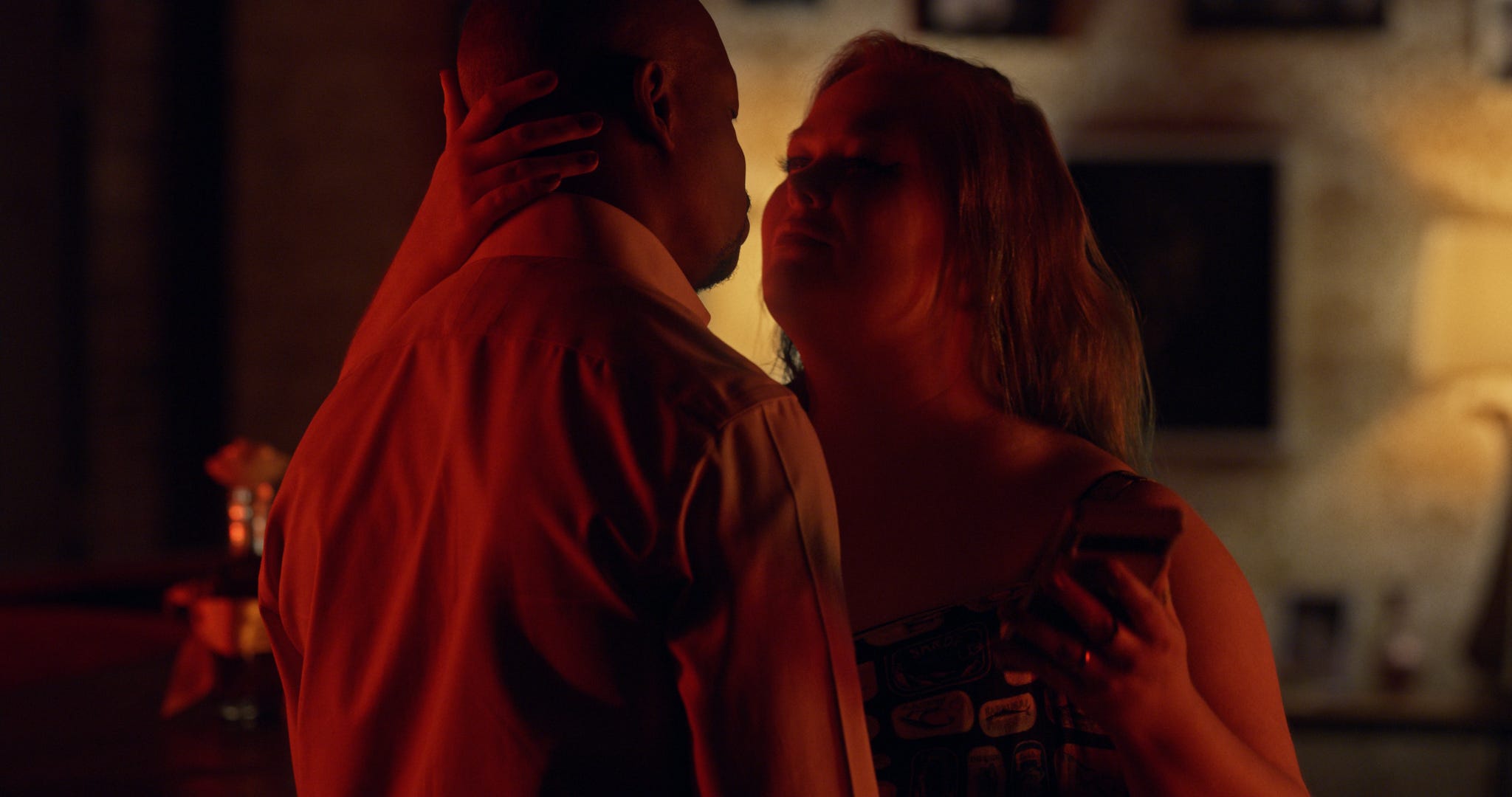
A strikingly lit and colored moment from Resentment
When you finish editing a film, you “lock” picture. At this point, the sequence of images that constitute the film is fixed. The reason why it needs to be fixed is that the next phase of post-production—designing and editing the soundscape, composing the score, color-correcting the footage, layering on any visual effects—uses the locked cut as a basis. If you made additional edits after the picture was locked, you’d need to do that whole process over again. The score would no longer be fitted to the rhythm of the images; there would be anomalies in the soundscape to be smoothed out; VFX would have to be redesigned; etc. The additional post-production work might be modest if the edits to the previously locked cut were minor, but they would cost time—and money. The efficient way to finish a film, therefore, is to lock picture and then move on.
Sometimes that’s not possible. I was twice involved on the producing team of a film that had to be radically re-edited after we’d gotten to what we thought was a locked cut. In the first case, we made the decision to hire a new editor before actually locking; weeks were added to the editing process, but we didn’t have to redo the rest of post-production. But in the second case, we’d locked picture, gone through the rest of post (including fairly extensive VFX), and submitted to festivals. When the film was rejected from Sundance and other top-tier targets, the director decided to open up the film and edit it again himself from scratch. The cut he came out with was not a plausible end-state for the film; it was a fairly impenetrable art experiment. But it revealed some truths about what the film wanted to be that we hadn’t realized in the previous round of editing, and when the director went back to the first editor with his new cut in hand, and they worked together from there, they ultimately cut a film that was far more coherent and satisfying on its own terms than the previous locked cut had been. It was an expensive choice, but it was the right one for the film.
We weren’t worried about having to make that choice with Resentment. We had confidence in the cut we’d locked. Now we had to polish it, and layer on these additional elements.
The process was significantly streamlined by the fact that our sound designer, sound editor and composer were all the same person, and by the fact that he was an old friend and longtime collaborator with our editor. In a film like Resentment, which is so dialogue-heavy, the primary job of the sound editor was to remove extraneous sound elements and make sure the dialogue was clear and natural sounding. Typically you’ve got multiple sources of sound—a lav mic worn by the speaker, a boom mic, possibly the lav worn by another actor as well—to work with for any given snippet of sound, and the sound editor has to choose between or weight these and then harmonize the various clips with each other so the stitching is inaudible. They have to do the same with music cues and with any non-dialogue sound recorded on set—things like glasses clinking or ice being stirred. The sound design then involves layering in additional sound elements to fill out the world and make it more real—and, sometimes, to underscore the action and dialogue emotionally. Doors opening and closing, bar sounds, crowd noise, sounds of the city from outside the bar—it’s incredible how much these things matter to making what you see feel real. Building a soundscape is a painstaking and subtle process, and one that you basically don’t notice when it’s done well.
Score played an unusual role in Resentment because so much of the music in the film is diegetic: the soundtrack playing in the bar. It was important as part of sound editing and design to manipulate the levels of the diegetic sound, bringing it down when necessary for dialogue clarity and up to fill sonically empty space or for emotional underscoring, but the idea was for the audience generally not to notice those shifts. Precisely because it was used rarely in this film, score would have a bigger impact, explicitly taking us out of the “real” world of the film, into either a narrative voice or, more often, the subjectivity of the characters, into their head space. Our editor had already layered in temp score where it belonged; now our composer needed to write music with the same structure and a similar tone. It was a real learning process for me working with our composer: I could generally feel the results, but I’m not very literate in musical terminology, so I had to learn how to communicate what I was feeling in terms that he could use. The whole collaboration was delightful.
Color-correction, similarly, is partly about harmony, partly about reality, and partly about emotional tone. Obviously, what you get in camera constrains what the footage will ultimately look like—but not completely. You light for a particular intended look, but if you light well you’ll have a considerable degree of freedom to alter that look in post. Raw footage looks washed out but it actually contains an enormous amount of information, and by suppressing some of that information you can significantly alter the look of the film. For color correction we also had a fourth collaborator: in addition to the colorist, my editor and myself, our cinematographer naturally had strong opinions about the choices we would make about how her footage would look. She had recommended the colorist we wound up working with, so she had confidence in their abilities, but color-correction isn’t a purely technical exercise. It can have a profound impact on the audience’s emotional reaction to a scene—and sometimes it’s not obvious what the right choice is.
We had a situation like that with Resentment, where we had to make a big-picture tonal decision and we weren’t sure the right way to go. Act II takes place in the bar at night, with a big crowd. The tension between Trish and David ratchets up and up and up over the course of the act. Realistically, the light should be low; emotionally, it should be tilted strongly toward red. If you leaned all the way into those choices, you’d get something like the early sequence of Gaspar Noé’s Irreversible, when Vincent Cassel descends into a club that is basically a version of hell. We obviously didn’t want to go that far, but even a more moderate version of that kind of color, of the kind seen in the bar in Martin Scorsese’s Mean Streets, for example, would have a visceral impact on the audience. But it might be too visceral. It’s one thing for an audience to sit through two or three minutes of conversation in a dark bar; it’s another thing to ask them to sit through twenty-five minutes straight in the same environment. There’s also a difference between a minute of dialogue bursting into an act of violence in such an environment, and being attentive to a long conversation. Whatever might be realistic light levels for a cocktail bar at night and whatever we wanted audiences to feel about the environment, we also had to consider the audience’s stamina and ability to attend to the full spectrum of emotions that played out over a very long set of scenes. The four of us batted the question back and forth for some time before settling on a tonality somewhere between the extremes.
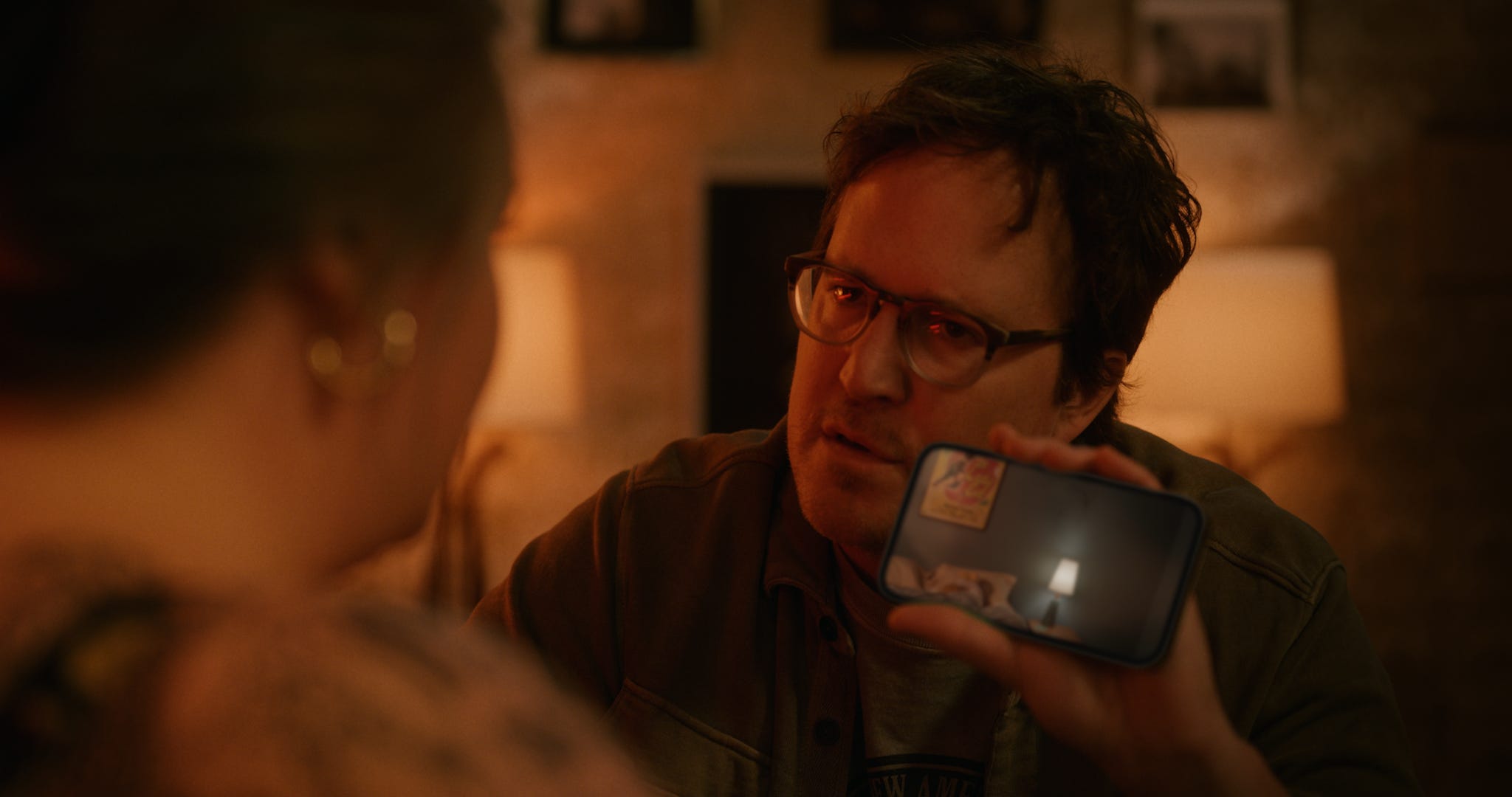
VFX includes little things like putting footage on a phone, as in this still from Resentment
You wouldn’t think there was much VFX in a film like Resentment, and there wasn’t—but there was some, and unfortunately there was some that wouldn’t have been necessary if we’d been more thoughtful about VFX during preproduction. One of the things that multiple people have commented to me about Resentment is the way in which it depicts a world that isn’t dominated by phones. In my cocktail bar, people are generally talking to each other, not texting with people who aren’t there. But phones are essential to multiple story beats, including some key turns in the plot. Any time we’re looking at a phone, and there’s anything on the screen besides blackness, that’s VFX. When David is looking at footage of Coleman’s film early in Act I, when Trish is looking at David singing to their daughter as he puts her to bed at the end of Act II, VFX’s job is to put that footage on the phone and to have it look seamless, even when, as in both of these cases, the phone is sometimes moving within the frame, either because the phone is in motion or because the camera is. But there were also VFX clean-up jobs to be done, situations where the phone was green-screened because we thought we’d have footage to put on it, but then we either didn’t have the footage or it wasn’t practical to put it on. In these cases, we needed to turn green to black—something we could have accomplished much more easily and cheaply by not green-screening the phone in the first place.
The last stage of post-production was the credits, in general a simple technical exercise. But at this point we also learned that we couldn’t afford the rights to the song that we wanted to use for the credits. It felt important to me that the song be meaningful, related to the themes of the film and emotionally connected to Trish, since the song under the opening credits of the film felt to me like it “belonged” to Coleman and since David sang a song in Act II. Our music supervisor provided us with a number of more affordable alternatives to the song we had wanted to use, one of which almost made the cut. But in the end, I worked with our composer to create a song written just for the film, which turned out to work better than anything we had considered licensing, and which we could now use for the trailer as well without needing to pay for additional rights.
It’s amazing how different a film feels at the end of post-production versus at the point of locking picture. Each of these changes is a small tweak in and of itself, and the shape of the film is, needless to say, identical to what it was at picture lock. But taken together they make the difference between something that feels rough and clunky in ways that prevent you from accepting it as a reality, and something that feels like a fully immersive film.
We finished post-production just in time to submit the film to Sundance, the Harvard of independent film festivals that everyone applies to and almost nobody gets into, and which we naturally hoped (but didn’t expect) would begin our festival run.
Previous entries in this series can be found here:
To keep up with the countdown to our release, please follow us on Instagram, on Facebook, on TikTok and on X. You can also add Resentment to your watch list on Letterboxd.