

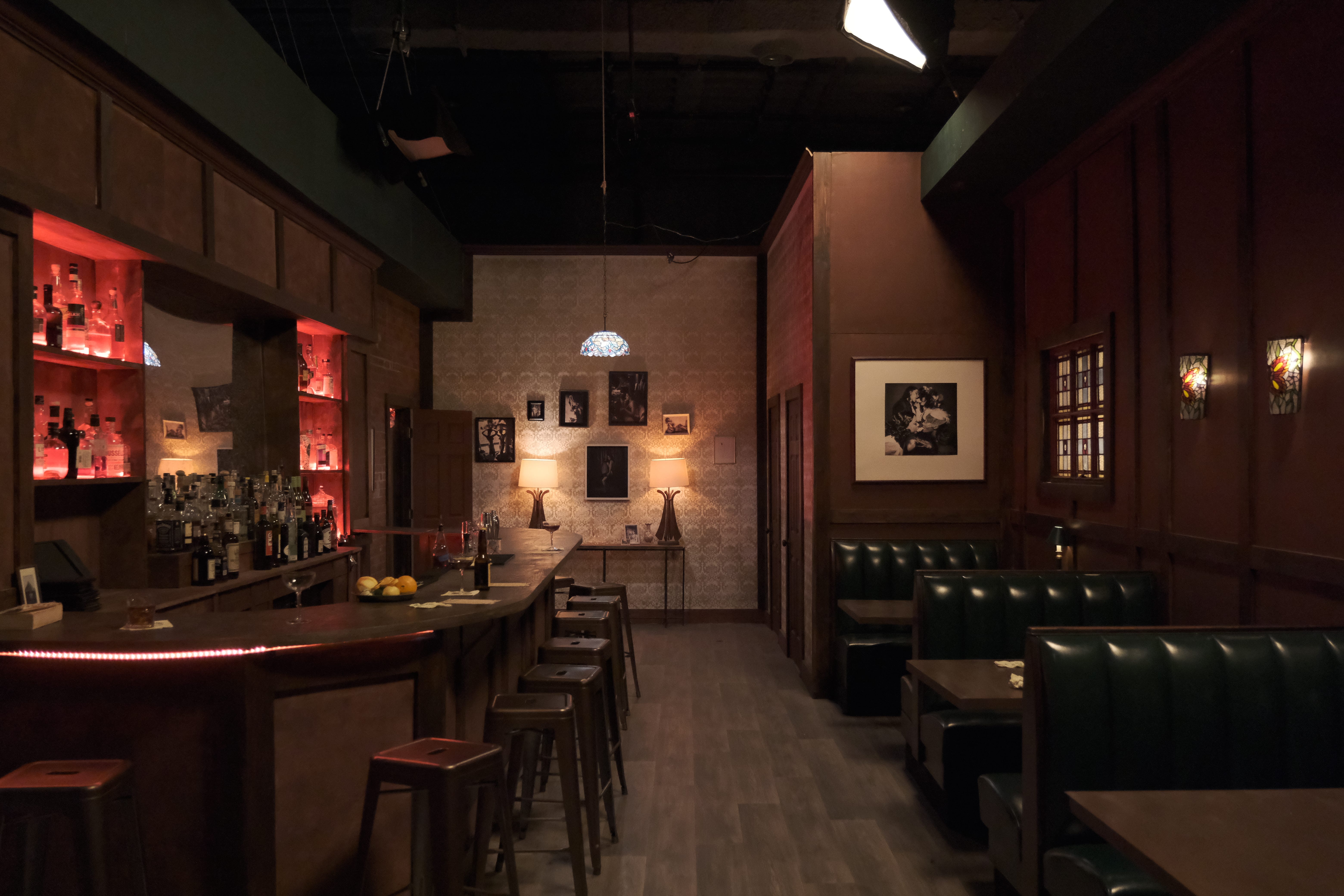
The set of Resentment, all dressed up and ready to get shot
June, 2023. That’s three and a half years since I wrote the first words of the script. After years of writing, revising, fundraising, casting and crewing up, after the whole process of preproduction including losing two shooting days, we would now have twelve days to actually shoot the film—eleven days on set and one day for all the shots that were not at the bar. I’d been trying to get back into the director’s chair for seven years, since we shot my second shot. That script, which was about 15 pages long, took three days to shoot—five pages per day. The script for Resentment was 86 pages long—to shoot it in twelve days we’d need to get through over seven pages per day. Even if everything went smoothly, that was a tall order.
Driving to set the first day, the auguries were ominous. We were in the midst of the airpocalypse. Smoke from wildfires in Quebec had drifted down to New York, turning the air orange and making everything smell like a campfire. Thankfully both for our lungs and for the footage, we were shooting indoors on a set. Had we been shooting outside, I can’t imagine how our actors would have performed in air they couldn’t comfortably breathe, or how we would have corrected the sky to its usual blue in post-production. I arrived to the first day of shooting excited, but also deeply anxious—and, though I didn’t fully recognize this at the time, what I was fundamentally anxious about wasn’t these external factors that could impact the production, but about me. This was the largest creative project I’d ever undertaken. A whole team of people were counting on me to lead them. Did I even know where I was going?
I certainly had to pretend I did. So I did my best, over my team’s breakfast omelets (catering meals is an absolutely essential part of producing), to communicate excitement and confidence. I have no recollection of what I said, but I don’t remember feeling very convincing.
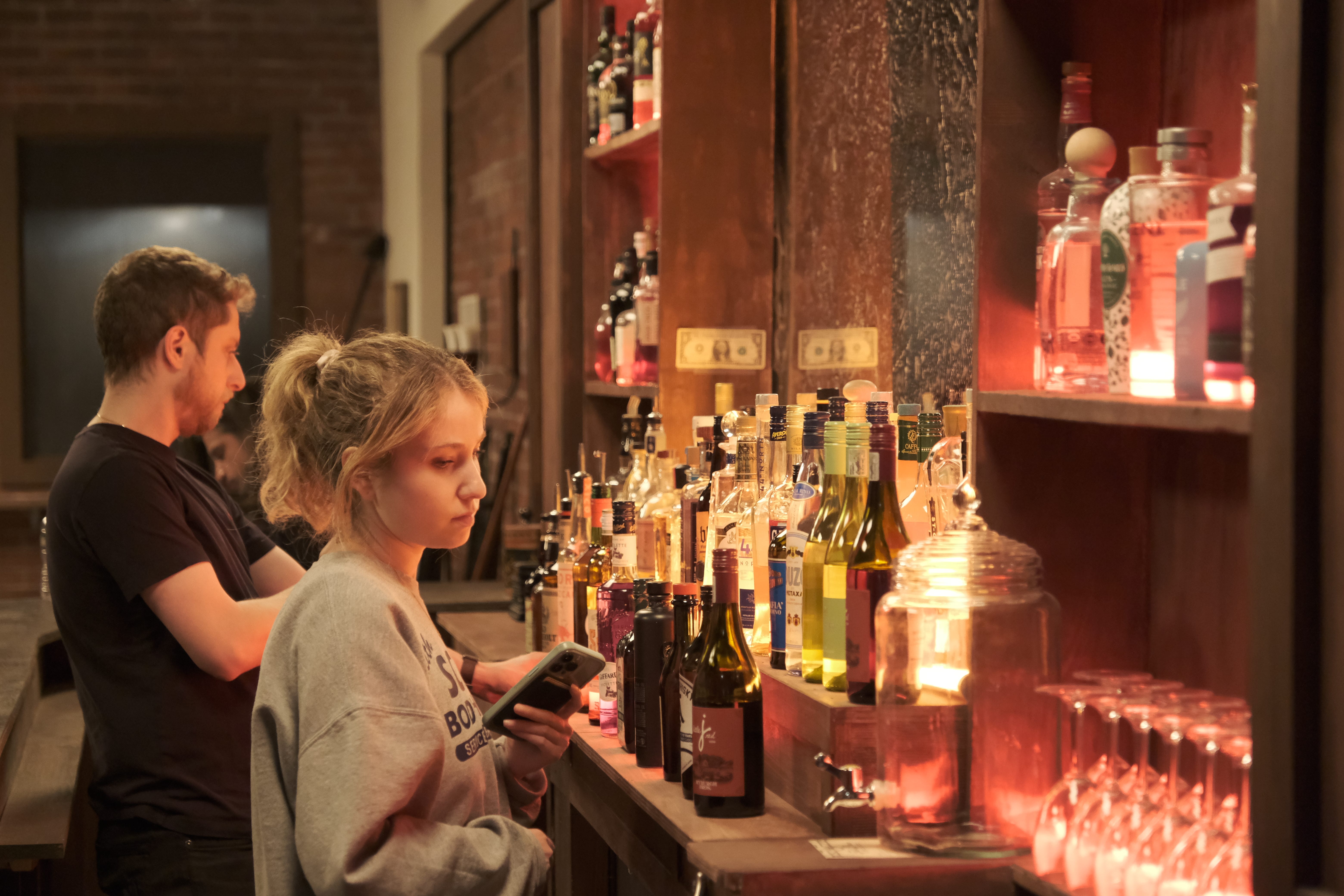
Resetting after a shot, making sure all the bottles behind the bar are where they belong
There’s no set rule about the order in which you shoot a film. One specific thing I had learned about scheduling from my prior experiences as a director and a producer was that you don’t want the first day to be too challenging. The cast won’t have fully sunk into their roles yet, and the crew won’t have gotten into a rhythm, so you don’t want to schedule emotionally difficult material or complicated shots for the first day. As for the shooting order within a scene, most commonly you shoot the master first: a wide shot that takes in the entire scope of the action. It’s an important part of coverage to have a shot that you can always cut to within a scene, and the master is the most versatile such shot. Moreover, the master also gives you an opportunity to capture the choreography of the entire scene, which the script supervisor can then make sure is matched in subsequent shots.
The day before, the crew had already pre-lit for a master shot of the entire bar pointed down the bar’s length from the from the far end of the room. From this vantage, you could see anyone coming in, and our principal characters for the scene, David and Coleman, would be having an intense at the other end of the bar. Our art department was putting the finishing touches on dressing the set—hanging the vintage burlesque photos on the wall, arranging the liquor bottles (which I had collected for months leading up to the shoot from all my cocktail-loving friends) on the shelves behind bar, setting out the shiny brass barware that the actor playing our bartender (who was a bartender in real life) had generously agreed to loan to the production. Everyone was eager to get off the first shot.
It was at this point that I saw that the shot was wrong. We hadn’t had a chance to scout so as to figure this out beforehand, but now that I could see everything, and knowing how the rest of the scene was going to be shot, I knew we would never use this master. It wouldn’t cut well with the rest of the footage we would get, and cutting to it would kill the momentum of the scene. If we wanted a master we could use, we needed to shoot it from the opposite direction. But we couldn’t re-light; that would take a ridiculous amount of time. What were we going to do?
This was the first important decision I needed to make, and I didn’t make it well. The right thing to do was either to shoot the master from this direction anyway, do a single take since I knew I wouldn’t use it, and get another master later from the right direction, or to skip on to the next shot that we would be doing from this direction and come back to do a master from the proper direction later, notwithstanding the challenge that would pose in terms of continuity. Instead, I got into an argument with my DP, dithered about what to do, and finally gave in and let her do what she thought was best. The whole thing wasted time, undermined my confidence in myself, my confidence in my team, and their confidence in me.
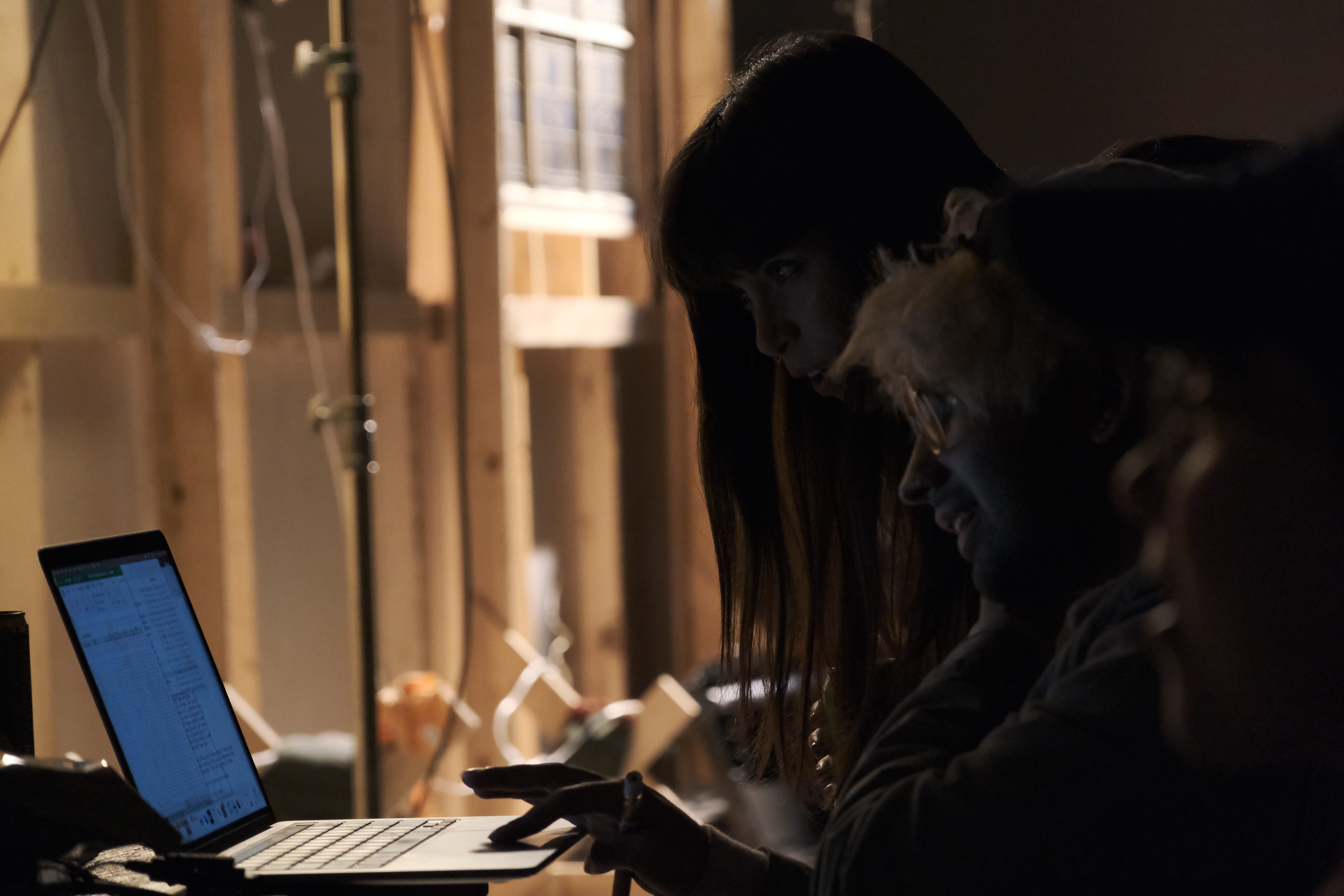
Our script supervisor, whose job I did not make any easier by having such long takes
Sadly, this set a template for the first few days of the shoot. I was short with the art department, with my producer, even with my script supervisor—who had an extremely difficult job keeping track of continuity with such long takes. I kept second-guessing myself, and therefore kept second-guessing everyone else too. At one point early in the shoot, one of my lead actors noticed that he was facing a particular way a lot in a scene, and suggested we shoot coverage from the direction he was facing. I liked the look of the shot, so I said yes—but that meant the shots from that angle wouldn’t cut with some of the other coverage because the camera had jumped the line. I dithered and fretted and berated myself before finally working with my DP on an adaptation (which worked out great, better than what the original shot list would have yielded). Later, in a steadicam shot from Act III, it was important to me that one actor appear to be leading the other as they both walked down the length of the bar on opposite sides thereof. The problem: for the scene to cut correctly, we needed to cheat their positioning so that it looked (to me) like the wrong character was leading as they walked. I must have gone around in circles a dozen times asking whether there was a way to make it look like the character I wanted was leading before finally giving up and letting the DP do what she needed to do. (It worked out just fine.) I didn’t trust myself, and as a consequence it was hard for me to anyone else in the way I needed to.
Sometimes, of course, you make a necessary call that does in fact solve a problem, but has other unexpected consequences. For example, our Trish was still out with COVID for our first day of shooting, so we had an extra made up to look like her for those shots where she might be visible in the background. But this extra simply could not take even the most basic direction like “this is your cue to enter” or “this is your cue to leave.” It was a huge waste of time and ruined multiple shots. We had previously planned to use SAG background actors for all featured extras and non-SAG for those extras who would not be featured, but after this experience I decided we had to go SAG for all the non-dialogue roles, featured or not. This proved to be a much more financially expensive decision than we realized when we made it (though I still feel it was the right one for the film).
A few days into the shoot, two people showed up who helped get me in a better frame of mind. The first was my executive producer. After one day of watching me work, he pulled me aside and said: Noah, you’re getting great stuff. The performances are great, the shots look beautiful. You need to relax, and you need to trust your team more, or you’re going to lose them. For whatever reason, that got through to me. I did—and the atmosphere on set quickly improved. The other person was my original AD, who had finished with the other job that had prevented him from working on my film, and now showed up to see if he could be of any use to me. I’m not sure how much we actually found for him to do, but just having him there to be an emotional support animal for me was a godsend.
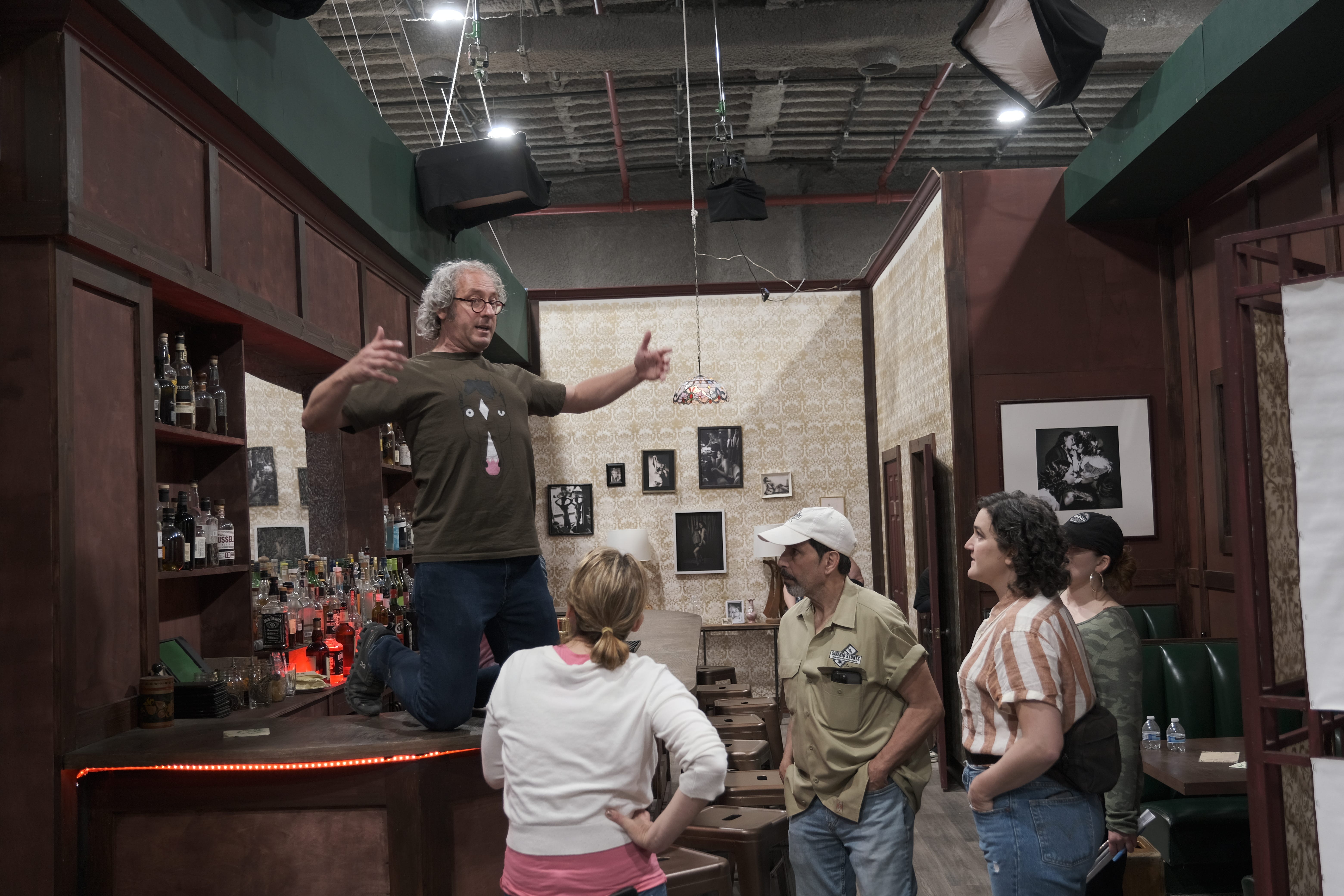
Discussing choreography with my DP, AD, stunt coordinator and intimacy coordinator
Two other people were godsends to me all through the shoot. One was my son, who was officially our Digital Imaging Technician (DIT), the person responsible for downloading and backing up the footage, but who helped out in a host of other areas as well, from camera loading to props to, well, really anything that needed doing, and who also drove with me to set every morning and helped me get my head straight on the ride over. The other was a friend from Portland, Oregon, someone who had never worked on a film before but was a huge movie buff and had flown out on his own dime, just to work on the film for free. He turned out to be invaluable, a true jack of all trades. We needed a fridge for the bar? He found us a used one, cheap. We needed labels for a featured bottle of brandy that needed to look classy? He designed and printed them. He also pulled me aside at one point and gave me a necessary lecture about how to handle my team better when I had questions about their decisions. He’d spent a lot of time in his previous career as a restauranteur handling difficult personalities in high-pressure situations, and he had a lot of wisdom to impart, which I tried my best to take in.
And then, of course, there was my cast, who I absolutely adored working with from beginning to end—the leads, the smaller parts, even the background actors, who I tried to give proper attention to, and to give them a sense of who they were in a given scene, someone specific to play, not just an action. Here, I felt like I knew what I was doing. I knew what was happening emotionally in every moment of every scene, so I felt confident about my ability to communicate that to the actors—and, therefore, also more open to their own suggestions for how to say or play a given line or moment. Frankly, I think my actors would have appreciated more input from me on specific lines—they were always grateful when I pointed out why I used a particular word, what the specific subtext of a phrase was. My desire to do long takes and let the dialogue flow unfortunately got in the way of my giving much of that kind of feedback. In general, though, I was more happy to talk to them after a take about how they felt about a given performance, ask them what questions they had, even tell them stories about where a particular moment came from, or stories that resonated with me for some reason. I wanted them to feel at home in the roles more than I wanted to give specific performance notes. I was still trying to channel Mike Nichols, I think.
Back when we had a fourteen day shoot, we were supposed to shoot Act I in four days. Now we had to do it in three—and we almost made it, leaving just one shot to pick up at the end of our time on set. On the third day, moreover, we got absolutely amazing takes from our Coleman of a lengthy monologue that I wanted to include as a oner. At the end of Day 3, we wrapped the background actors from Act I, but two of them had enjoyed working on the set so much that they asked if they could come back when we shot Act II. That made me feel much better about the atmosphere on the shoot than I had felt to that point.
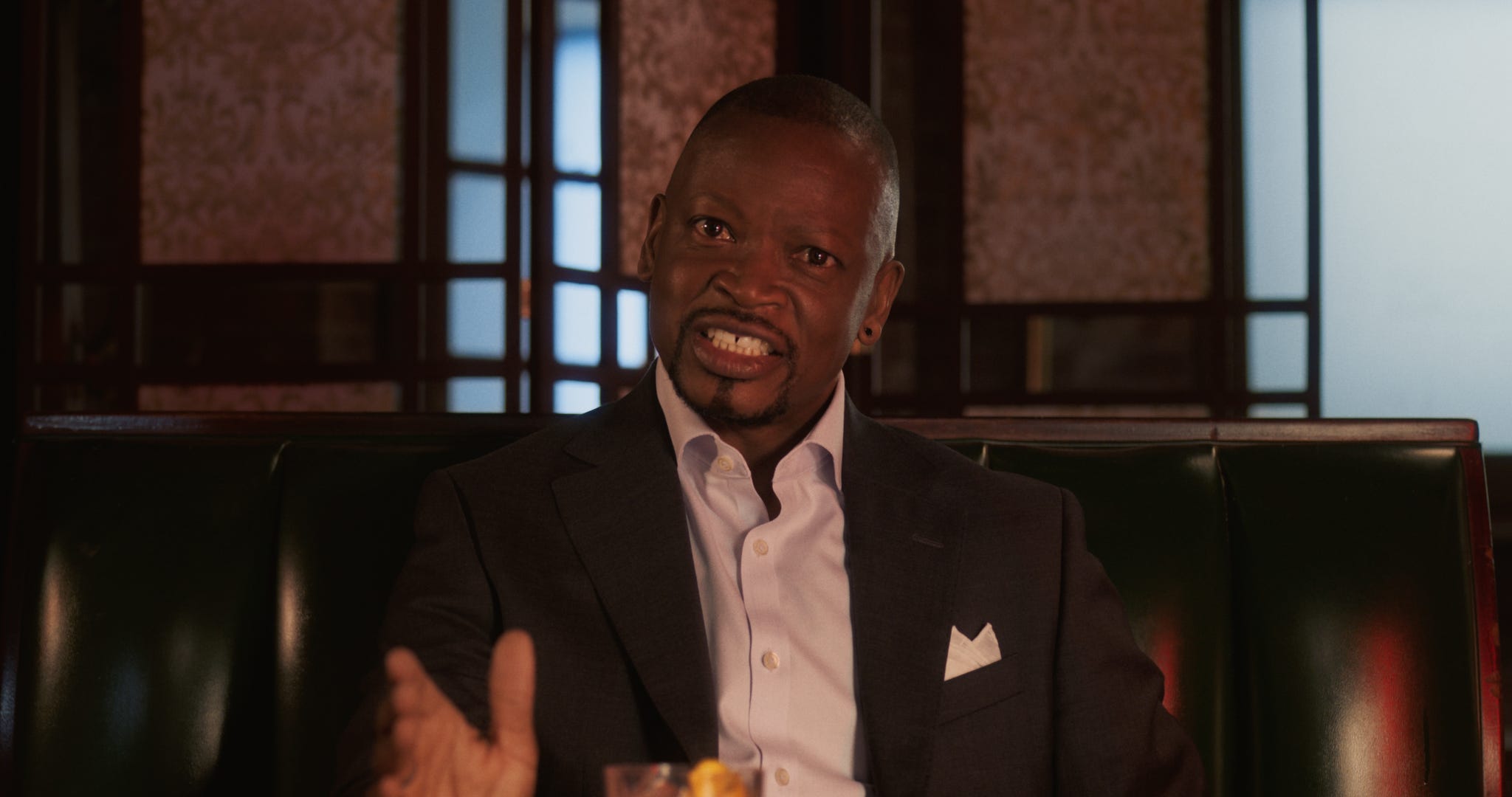
Lawrence Gilliard Jr.’s monologue as Coleman in a still from Resentment
By day five or thereabouts, in the middle of shooting Act III, I felt like we were hitting a groove. That didn’t mean problems didn’t keep cropping up—they did. It just meant that we were responding to them more fluidly rather than in a brittle fashion. We struggled to do long takes with the steadicam, so we wound up shooting shorter takes. We lost our first steadicam operator after a day and had to work with another one, who had a very different style from the first one—harmonizing the footage would be a challenge in the editing room, but in the moment we just rolled. We had two lighting effects in Act III that we weren’t sure how to execute; my DP and her team—who were regularly working lighting miracles on a shoestring budget—solved both with alacrity. Act III also had one of our intimate scenes, and both our actors and our intimacy coordinator delivered emotionally resonant and consummately professional work. And Act III depended especially much on performance. The film as a whole is play-like, but Act III is emphatically so, as most of the action is just Coleman and Trish talking in an otherwise empty bar. I’d thought a lot about how to make that feel cinematic, but ultimately it was on my two actors to hold the audience by bringing their characters to life, and they delivered marvelously.
Act II, on the other hand, which we shot after Acts I and III, was the most complicated part of the film to shoot. It had the most shots, the most complicated choreography, the most speaking parts, the most background actors to keep track of, the most locations (even though most of it was still on the set) and the most complex emotional arc for its two principal characters, David and Trish, whose marriage seems to be coming apart as the night wears on. So of course we also had the most amusing problems crop up. (Thankfully, we had added a day to the shoot by this point; so that we had the full six days originally planned for shooting this Act II on set.) The central set piece of Act II is a dance on the bar, and at the last minute we discovered we couldn’t do what we planned for a variety of reasons (the bar was narrower than anticipated, one performer was so tall his head would have gone through the ceiling, etc.). We had to change the choreography and how we were going to shoot it on the fly. At one point we built an additional platform on top of the bar. At another, we improvised a pseudo-dolly shot of Trish’s face as she walked along by raising the tripod to its maximum height and then rolling it along the floor while shooting. At yet another point, we realized we couldn’t shoot a shot from Trish’s POV on the bar by putting the DP on the bar holding the camera because it wasn’t safe, so we used equipment left behind by the studio (which was still under construction) to improvise a kind of crane, and get the shot that way.
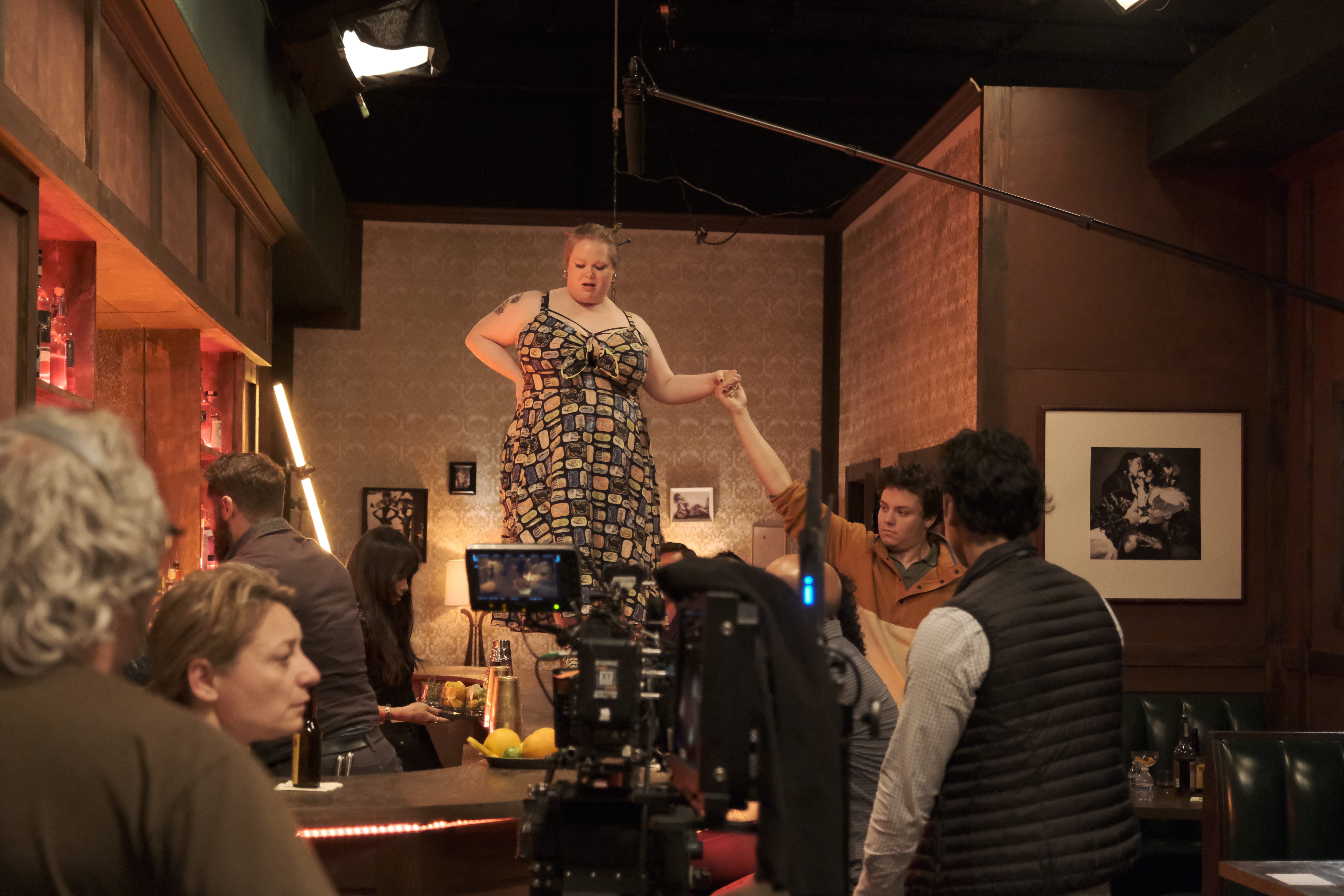
Rehearsing a walk along the bar
It was wonderful to feel decisions we had made under pressure during preproduction turn out to be godsends. Switching out the artwork, for example, gave us a host of images on the walls that we could framed in shots to impart another layer of meaning to a given moment. It was also wonderful to occasionally feel vindicated about ideas I had had during shot listing that had been altered by necessity. When we finally got a gorgeous shot from behind the bar mirror, my DP turned to me and asked, why don’t we do more shots from here? Well, I pointed out, if we had shot according to the original schedule, we would have.
Meanwhile, other problems continued to crop up, and get solved, away from the camera. I’ll mention three. At the end of Act II, David sings a song to his young daughter as he is putting her back to bed. I had a song in mind, but at the last minute we learned that we couldn’t afford the rights. Since it was to be sung on camera in just a few days, we needed a replacement—and quickly. My wife suggested I ring up a friend who is a composer and lyricist, and see if she could write something. I gave her the “story” of the song stanza by stanza, and overnight she turned around a draft that was perfect—better, my actors felt, than the song we had originally planned to use. Then later, also at the last minute, we discovered that we couldn’t use the child actress who was supposed to play David and Trish’s daughter. My wife came to the rescue again, suggesting a friend who had a granddaughter just the right age, and who performed perfectly in the role. (I hope we didn’t give her the acting bug.)
The third problem I thankfully wasn’t fully aware of at the time, as it might have given me a heart attack. We were shooting digitally, which meant that all the footage had to be downloaded from the memory cards onto hard drives, the drives backed up twice, and then the cards wiped and reused. Due to a miscommunication before the shoot, we had acquired the wrong drives, and they kept crashing and needing to be reformatted. Since everything was double backed up, this was mostly an annoying waste of time—but at one point two drives failed simultaneously, and the entire film was sitting on a single drive. If it had failed too, we would have lost everything. Thankfully, nobody told me about this problem until the shoot was over; my son, the DIT, pressed additional hardware into service, got everything properly backed up, and got all our footage over the finish line.
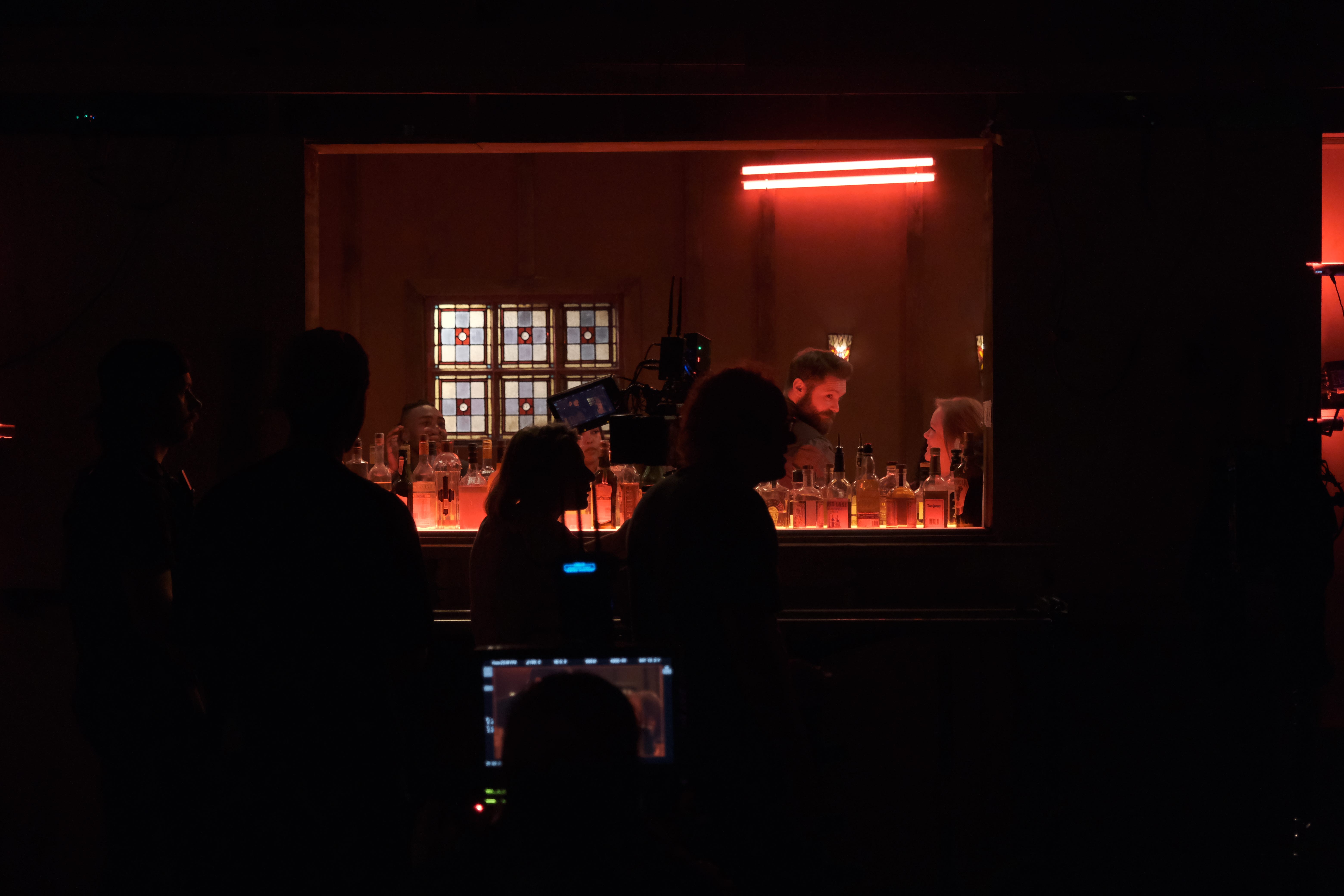
Getting a shot from behind the bar mirror
On our last day, with a skeleton crew, we shot all the scenes that didn’t take place in the bar in a brownstone that belonged to our friends (which they let us use for free). Nine scenes, seven locations, four and a half script pages, and we had to do it all in one day. We did it, with time to spare. A few days later, we had a wrap party at Sid Gold’s Request Room where we could sing our hearts out in celebration and drown our less-joyful memories in alcohol. I was proud of what we had accomplished, grateful for the incredible work that the whole team had done, and eager to get into the editing room.
Previous entries in this series can be found here:
If you want to keep up with the countdown to our release, you can follow us on Instagram, on Facebook, on TikTok and on X.