
Resentment: From First Draft To Final Draft
Scripts are never finished; they're just abandoned to the producer. But what if you are the producer?

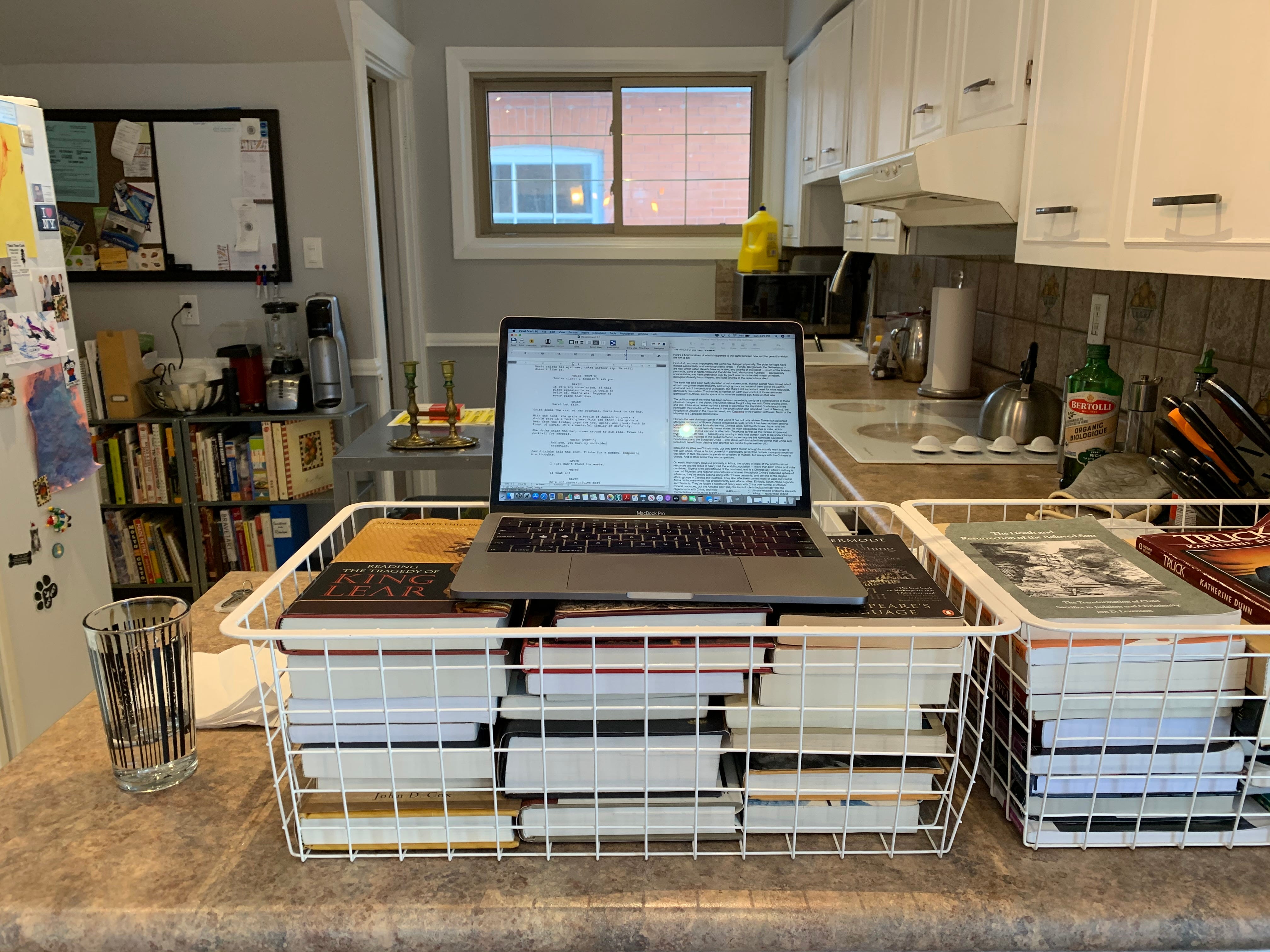
The Resentment script, in process of revision, resting on a bed of other, heftier texts
The first substantial feedback I got on Resentment was from the writing group I then belonged to, which is now defunct. It was not, on the whole, helpful. I remember distinctly an emblematic piece of feedback from one of the participants, a writer and filmmaker who had made at least one feature film and was instrumental in founding an important local film festival. “I think your inciting incident happens on almost the last page of your script,” he said. “You should just start from there, and consider all the work you’ve already done to be research.”
Now, there’s a way to give a note like that. The way is to say something like, “at the end of the script, I was really curious about what happened next. I even found myself wondering why you chose this particular frame to explore these characters. Have you thought about the next chapter? What draws you to this particular part of the story?” If the story isn’t working for you as is, and all you can think to say is “write another story,” then what you need is a better understanding of what the writer is going for in order to give useful feedback. After all, there is presumably a reason why they chose to tell the story in this frame, why this story is what they were moved to write. If I wrote a story about growing up with an abusive father, and you, a reader, found a secondary character—the protagonist’s boss, say—really well-drawn and interesting, more so than the protagonist, you can’t say “I think you should drop this story and write about the boss.” You’re not a studio executive; you don’t have the ability to green light a story about the boss. You’re in a writing group, giving feedback to someone who, presumably, wants to write the story they chose to write. You can absolutely say “I think the boss is so well-drawn—if you have a story about him too, I think you could make something great out of that.” But if the writer is coming to you asking for feedback on this story, the feedback really ought to be on this story.
Rant over—but there is a piece of advice, wisdom I find hard to take myself, buried under the rant. If you’re writing something, you need to know what that something is, what is essential to it and what isn’t. You want it to work, and you need to seek out and take in feedback that will help make it work; you can’t be so precious about everything you wrote that you defend everything to the death. But if you don’t know what it is, then you can’t possibly know how to make it work, and so you can’t know what feedback to take, what feedback to reject, and what feedback to transform, by which I mean: what feedback do you have to listen to but not accept, because it points to a problem that is real even though it misunderstands what the problem is, to say nothing of how to solve it.
My script in fact had a problem that was closely related to this feedback which I rejected, and I’m not sure I ever solved it at the script level because I didn’t hear the feedback the right way. “Your inciting incident happens on the last page” really meant “I got 10-15 pages into the script, hadn’t figured out what it was about yet, and gave up.” He needed something in the script that told him clearly “the story has begun” and this particular reader didn’t find it.
The reason why he didn’t find it is that I was hiding the ball, deliberately. Things are revealed in Act III of the script that fully explain the behavior of characters in Act I, things that you might intuit right from the get-go, but that you also might not. Alfred Hitchcock talks about the difference between surprise and suspense as follows: Suppose there are two people sitting at a table with a time bomb hidden underneath. If the audience doesn’t see the bomb, then when it goes off it’s a surprise. But if we see the bomb some time before it goes off, then until it goes off we’re in a state of suspense. Do the people sitting at the table know about the bomb? If not, will they find out about it before it goes off? We can anticipate what’s going to happen, and we’re on the edge of our seat until it does. In my script, two of my characters are behaving strangely, as if there’s a metaphorical bomb under the table, but we can’t see the bomb. I wanted my audience to wonder about that odd behavior, and wonder whether there is (metaphorically) a bomb that they can’t see.
That’s a perfectly valid thing to do. It’s what Edward Albee did in Who’s Afraid of Virginia Woolf—a touchstone for me in thinking about my script from the beginning. In Albee’s case, we don’t know that George and Martha’s son is imaginary until the end of the play, so when the story begins, we don’t really know why it has begun, or what the story is really about. If we’re paying close attention, though, we notice that George reacts very strangely when Honey tells him that Martha told her about their son, so strangely that while we don’t know where the bomb is, we can intuit that there’s a (metaphorical) bomb hidden somewhere in that vicinity. So it’s valid as a strategy—but it’s tricky. It’s asking a certain amount of patience and inherent curiosity from the audience, asking them to take on faith that the things they are seeing are being shown them for a reason, and for them to be interested in finding out that reason. I would have benefitted from feedback from someone who understood what I was trying to do, and had advice on how to make it work better. In the absence of that, I would have benefitted from thinking harder about why I was getting feedback from at least this one reader that my whole script felt like research, and not like a story at all.
I do think we pretty well solved this problem, though not at the script level. We solved it partly in the shoot, creating a shot that helped plant a certain thought in the audience’s mind, and partly in the edit, in terms of how that shot was used, how music and sound design was used at that moment, what other shots we used and didn’t use around it, all to build a moment that I think works really well. But it’s always better to anticipate these kinds of things if you can, and solve them at the script level.
There are other categories of feedback I rejected. Whenever someone told me to change something because it made a character “unlikable,” for example, I would tune them out. Again, though, that’s an area where I would have benefitted from listening with a different ear. No, characters don’t need to be likable—some of the best characters in cinema are appalling. But they do need to people we care about, or we will stop watching them. So when someone would say they don’t like a character, I should always have said to myself: hmm, if they’re saying that then they must not care about them. Why not? What am I hiding that, if I revealed, would make someone care about this character even if they still don’t like them? That something doesn’t need to be a trauma that invokes pity or a kind act—a “save the cat” moment—that shows the character has a warmer side. It doesn’t have to be—it shouldn’t be—something inorganic or expository. But there may be something intrinsic that is just not visible enough, something I already know and explains why I care, but that the reader doesn’t know yet, and, with edits, could.
I got some feedback of that sort, and I think it benefitted the script enormously. Indeed, plenty of people did give me very helpful feedback, on a micro and a macro level. But while I’m not sure how many drafts Resentment went through because it all depends on how you define a draft, I will say that the story and characters didn’t really change much over that process. For better or worse, I knew what I was going for from the beginning. I took the advice that helped me get closer to that goal, and rejected advice that suggested other goals—which, I will reiterate, is generally the right way to go.
Possibly the most helpful thing I did over the course of revision was arrange a virtual table read on Zoom, using actors I knew to play the various roles and inviting a handful of other friends to listen in and give me their thoughts. Just listening to the flow of the dialogue was exceptionally helpful in showing me where it could be tightened or made more fluid, but I also got some very valuable notes from the actors about moments that bumped them as they were reading. For example, I remember the actor playing David pointing out to me that there was a missing transition at one tense point in his conversation with Coleman, where his character plays a particularly explosive emotional card without any real warning. There was some internal process that brought him to that point—and I knew what it was—but it wasn’t in dialogue so he couldn’t play it. Notes like that definitely improved the script, and I wouldn’t have gotten them without doing a proper reading with accomplished actors.
The part of the script that changed most over the various drafts was the opening. I wrote many versions, altering my vision repeatedly partly in an effort to bring the budget down, but more fundamentally because I think how you begin a film sets expectations for the entire thing, even when you don’t meet the protagonist until well into the film (as is famously the case with both Casablanca and Star Wars). In my case, I was very worried that whoever I introduced first would be interpreted by the audience as the protagonist, and the whole film would be read through that lens, whereas what I wanted was for the three central roles to have equal weight. What we wound up creating in the edit doesn’t perfectly match any version of the script, but I think it does a better job than any of those versions of starting us on an equal footing between the three central characters. Since we weren’t going to do what Stephen Frears and Mick Audsley did in the opening sequence of The Grifters, I think what we did works about as well as it plausibly could.
The most consequential change that I made in the course of rewriting, and it was a change internal to the first draft (do incomplete drafts count as drafts? I don’t think so), was making Coleman a Black man. I hadn’t given any particular thought to the racial or ethnic background of the characters when I started writing, but I noticed that in my mind they seemed to be three White people, and at a certain point I wondered, well, why should that be? This is 2019; there’s no reason for all of them to be White. I decided to make one of them Black, and on one of my long walks I tried changing each of them in turn, seeing how they would feel in my mind, and it didn’t take long for me to settle on feeling like Coleman (who had a different name previously) felt the most right.
What was most interesting to me, as I wrote from that point onward, was that Coleman himself didn’t change much—but the two White characters did. Writing Coleman from the inside, I didn’t feel particularly self-conscious except about textural things, things that I knew I could get help from an actor on, but that I didn’t want to risk losing an actor over during a read of a draft that got those things wrong. And when David was interacting with him, he didn’t change that much (and I hadn’t yet written the Trish-Coleman scenes). But when my two White characters, David and Trish, got together without Coleman—when he was the subtext, but wasn’t in the room—suddenly race loomed. This wasn’t a conscious choice; it’s just what happened, and what felt right as I wrote. I don’t know if that says something about me, or about that moment in time (I was writing in 2019 and 2020, remember), but I certainly found it interesting. I hope you do too when you see the film.
In any event, only days after the session where my writing group discussed my script, the city of New York shut down over COVID. For the next several months, I wondered whether movies were still going to be a thing. Could I turn the script into a podcast? I didn’t think so—and I didn’t want to, honestly. For the rest of 2020, I worked mostly on other things. Then, once the pandemic abated, and it became possible to imagine making a film again, I wondered about the setting of the film. It was supposed to be set in the present—but bars were still closed for indoor dining. How could I incorporate the pandemic into the film? I did a draft that did the opposite, setting the film firmly in the immediate pre-pandemic period. But as time ticked on, it became obvious to me that this was a dodge, that the film needed to be set firmly after the pandemic, and that the pandemic needed to be part of the story of these characters’ lives, part of what brought them to this place. So I did another draft that brought COVID forward, making it as explicitly part of the story.
By the time we shot the film, however, some of that COVID-related stuff was already feeling dated. I cut some of it before shooting, and much of what was left in the shooting version of the script wound up on the cutting room floor. But I think all those revisions were nonetheless important. They kept the script rooted and specific, even as it changed. For all that we want our work to be timeless, what makes work timeless is that it transcends its time, not that it isn’t rooted in its time, just as what makes something universal is that it transcends its culture and place, not that it isn’t rooted there.
How do you know when a script is done? The only real answer is: when someone is ready to make it. In my case, that meant when I was ready to stop showing it to people in the hopes of getting feedback, and start showing it in the hopes that they would invest, or sign on to produce.
In my fantasies, I had dreamed that I’d be shooting by late 2020. Instead, by the fall of 2021, I was just starting to raise money and assemble my team.
Previous entries in this series can be found here:
If you want to keep up with the countdown to our release, you can follow us on Instagram, on Facebook, on TikTok and on X.