
Chevrei Lev
Thinking about Birthright on the eve of Tisha B'Av

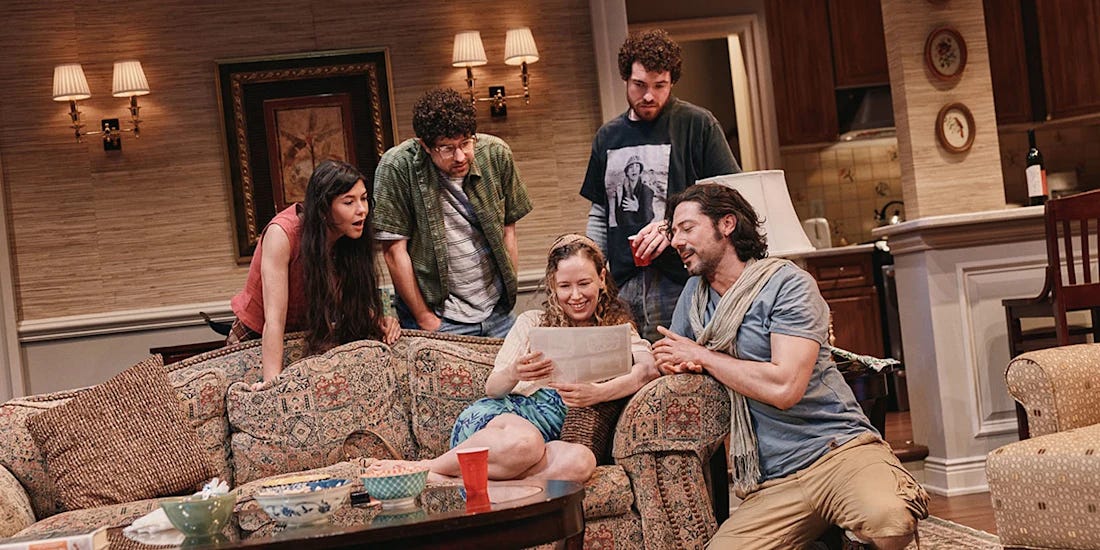
Zoë Winters, Eli Gelb, Molly Ranson, Nate Mann and Hale Appleman in Birthright at MCC Theater
The Big Chill came out right when I started high school. As a seminal work of Baby Boomer nostalgia and self-involvement, you would think that it would land like a lead balloon on my consciousness. I was absolutely not the demographic being targeted.
Weirdly, the film not only landed but became a fixation for me and for some of my core friend group among my fellow high school debaters. We watched the film over and over again. At the time I had no idea why, and by the time I got to college I was embarrassed to have ever been so attached to something not only so uncool but so irrelevant to my actual life—I felt like I’d submitted to Boomer brainwashing. Years later, one of my closest friends, who had been part of that high school debate group, explained to me why the film had meant so much to us. We were all weirdos who weren’t sure we’d ever find a place we belonged, and yet we’d found each other, found our group. The film suggested that, twenty years down the line, we might still be friends, might still love each other, might still think of ourselves as a kind of chosen family. As it happens, the friend who offered that explanation is the only one I’m still close to and in touch with from those days, but the film still has a bit of a halo for me because of the hope that she explained it had nurtured.
This past weekend, my wife and I went to see Birthright, a new play at MCC Theater that owes a transparent debt to Lawrence Kazdan’s film (which was called Chevrei Alex, “Friends of Alex” in its Israeli release). The play is about a group of American Jews who met on a Birthright trip to Israel in 2006. For those readers who don’t know, Birthright is a program that sends young Jewish adults on short all-expenses-paid group trips to Israel as a bonding exercise: to get them to bond with each other, and to get them to form a bond with Israel. It was founded by famed Jewish philanthropists Charles Bronfman and Michael Steinhardt, and its explicit purpose is so-called “Jewish continuity,” which is to say: making sure the next generation of Jews identify and affiliate as such. The play follows the group through the subsequent 18 years, as they age and the world changes, but the play isn’t really interested in whether the trip achieved its aim—whether this group of Jews did, in fact, remain Jewish as a consequence of the trip. Rather, it takes their Jewishness largely for granted, and, while tracking them through their and the world’s changes, asks whether they have remained or even could remain the kind of chosen family that, when we first meet them, they think they have become.
When we first meet them, just back from the trip a few weeks prior and still buzzing with excitement, they are as clearly differentiated as types as the characters in The Big Chill—or, perhaps better given their youth and the crucible-like conditions under which they became a group in the first place, as the characters in The Breakfast Club. Chaya (Zoë Winters) is the queen bee: she’s superficially confident, even domineering, with her friends, her mother, (Liz Larsen), and her sexual conquests. Izzy (Molly Bernard) is the dissident: she’s a lesbian, for one thing (though she did hook up with one of the guys on the trip), and she had a nagging feeling the whole trip that there was something off about it. Izzy and Chaya are the only alumni of the trip who knew each other beforehand—they are supposed to have been friends since preschool, though they are so unsuited to each other that absent that history it’s hard to imagine them becoming friends at all (itself a common enough phenomenon). Noah (Eli Gelb) is the nerd: he’s a socially-awkward news junkie who became a first-generation blogger and he moons over Chaya. Emerson (Nate Mann) is the stoner: a musician whose band broke up just after achieving its first success, he’s clearly a budding addict, and he also has the least connection with organized Judaism of the bunch. Alona (Molly Ranson) is the innocent: she’s equally wide-eyed about the experience of being in Israel (and at having lost her virginity to one of the IDF soldiers charged with guarding the Americans on their trip), to the point that she’s fantasizing about making aliyah, something Chaya is determined to dissuade her from at the play’s outset. Finally, Zev (Hale Appleman) is the seeker: he left the trip partway through (without saying goodbye to Izzy, who he’d just hooked up with) to see the “real” Israel on his own—and also to visit Egypt, Jordan and the West Bank—and now, only weeks later, he’s planning to become a rabbi.
I suppose one could play the same game with characters from Chekhov, but there are such powerful currents coursing beneath the surface in Uncle Vanya or The Three Sisters, and no such depths seemed likely to be sounded here. Rather, the point seemed to be for them to be a representative group, sociologically and in terms of the spectrum of personality types, so that the audience might look at them and listen to them and say: oh yes, I was just like her at that age, and I totally knew that guy. I suppose you could say that Chekhov is doing that as well, that he is also painting a portrait of a stubbornly stuck and self-involved society built up from a collection of representative types that Russians of the era would instantly recognize. So perhaps all I can say definitively is that I did not like these people, that I did not identify. I have in common with them the experience of finding a group and desperately wanting it to remain a group; I have in common as well the experience of the kind of island in time that a Birthright trip must surely be, and the sense such islands engender that this shared experience has bound the group together, brought them closer in a way that normal life does and could not, even as it proves difficult to integrate the people from the group into that normal life. And, of course, I care about Jewish stuff—a lot. Nonetheless, I didn’t see myself, or people I know and care about, in them. I found them shallow, smug and self-regarding, and I didn’t want to hang out with them—at all.
Absent that identification, I struggled to stay emotionally engaged as I traveled with these characters through time. Act I basically sets them in motion. Act II brings them together again for a reunion ten years later, in 2016, at Alona’s wedding (she’s marrying an Israeli, but not the one she hooked up with on the Birthright trip). Just like Alona, all the others have aged but they are all still the same as they ever were. Emerson has been in and out of rehab. Noah is a Matt Yglesias type who has founded something that sounds an awful lot like Vox; he’s married, but still clearly has the hots for Chaya. Chaya has been working in the Obama White House, something she talks about constantly and uses particularly to lord over Izzy, and she is also in a relationship, but has clearly started to warm to Noah, or perhaps is just feeling randy (they’ll have sex in the hot tub before the act is out). Izzy has been drifting steadily leftward, which among other things has meant toward anti-Zionism; her political antipathy blends easily with the grudge she holds against Chaya for being a bad friend as she sees it, when really they would never have been friends in the first place were it not for their shared childhood history. Zev, finally, never became a rabbi; instead he got married, had a kid, and got divorced. He’s still clearly seeking answers of some kind, but his joy in the quest is gone.
Then Act III brings them together again in 2024 for a funeral—Zev’s, who appears to have taken his own life. This is the same device used in The Big Chill, and for the same purpose, but our having seen Lev alive, and having seen all these people as their younger selves, undermines that purpose—or, perhaps, inverts it—because we know too much. The surviving members of the group all want to mythologize Lev and claim him for their own perspective on the world now. Izzy wants to claim that he, too, has become a thoroughgoing anti-Zionist who hates Israel; Chaya wants to claim that, on the contrary, he had cut Izzy out of his life precisely because of her outrageous opinions and behavior around the topic of Israel. Alona has moved back to the U.S.A. because, between Hamas and Hezbollah on the one hand and Netanyahu and the Israeli extreme right on the other, with endless war and missiles repeatedly disrupting ordinary life, she can no longer bear to raise children in Israel. But she feels like she has abandoned Israel to its worst people and its worst instincts—and she, too, cites Lev as someone who urged her to stay and fight. Even Emerson—who shows up late, wearing ultra-Orthodox garb, having become baal teshuvah some time over the past eight years (his entrance is a good laugh line, though once again, the laugh depends on the fact that he’s fulfilling a preexisting stereotype)—turns out to have had an ongoing Lev connection: they were on-line study partners, and he thought Lev was groping toward some kind of return himself.
But we’ve seen Lev. He wasn’t some guru or saint. He was just another guy, someone who made bad decisions (like marrying and having kids with the wrong woman) and didn’t know how to deal with their aftermath. He might have had some serious mental illness brewing, but that might just be me reading backwards from his end; the signs were there, but they were appropriately ambiguous. So the group’s myth-making to me felt desperate, a sign that there was nothing else left to hold them together.
Which is true, when I thought about it. These people aren’t part of each other’s daily life; they don’t even have a substantial history together. They were thrown together for ten days at a particularly formative time of life, and they’ve parlayed that over the years into a sense of continuity. But continuity of what? What, really, is the substance of the relationship they have? Don’t get me wrong: I have some very close friends that I’ve made under not totally dissimilar circumstances. It’s swimming upstream to sustain them, though, and it’s impossible if we aren’t there for each other in a substantive way, even if not physically present, through the real events of life.
The play ends with the group saying kaddish for Lev—they use Chaya’s mom’s book group, who they call in by video, to make a minyan, something a real ultra-Orthodox Jew would not go for (also, what book group has eight men in it?)—and I found myself musing on who they were really saying kaddish for. Lev’s name means “heart,” and his funeral takes place eighteen years after their first gathering—eighteen famously being the numeric value of the word chai, “life.” I doubt those are coincidences; even though the play tries hard to bring the group to some kind of closure, some feeling of togetherness, which that kaddish is a part of, I think we’re supposed to wonder whether the group can actually continue, whether it still has any life, now that its heart has taken his own. But I found myself wondering whether it was ever really alive in the first place.
And that thought began to ramify as I realized that I was seeing the play only a few days before Tisha B’Av, the fast day in memory of the destruction of the First and Second Temples, which begins tonight. I’ve written about the holiday before (see here and here), and I’m planning to fast again this year (a return to a practice I had abandoned), but the spirit of that fast has changed yet again. More and more, I can feel myself anticipating destruction, and preparing myself for it by a kind of internal distancing. I don’t know the nature of the destruction, and I have no pretensions to being a prophet, but I can see the Third Jewish Commonwealth going down a path reminiscent of the ones that led to the destruction of the First and Second, and I am filled with foreboding. Perhaps we’re supposed to take from the play a sense that Lev shared that feeling, that this is what ultimately led him to take his own life. If so, though, then it’s a pretty searing indictment of this group that they are all primarily interested in claiming his corpse for themselves, to vindicate their own rightness, as if that was what Israel—the place that brought them together in the beginning—was only ever about that for them.
These people all think of themselves as good liberal lefties, all think of themselves as examples of the best, all feel betrayed, most fundamentally, by the world itself for not living up to what they had been promised of it. But the more I think about these good liberals and lefties, the more I feel like they are imbued with the spirit of Kamtza and bar Kamtza, the pair of Roman-era Judeans whose petty rivalries led to the destruction of the Second Temple. Their story and its consequences is the only piece of Talmud you’re supposed to study on Tisha B’av. It’s also a story I imagine Lev would have appreciated, and been haunted by.
Birthright runs through August 23rd at the MCC Theater in Manhattan