
The Stone Rejected By the Builders
Could the Arab parties be the key to transforming Israeli politics?

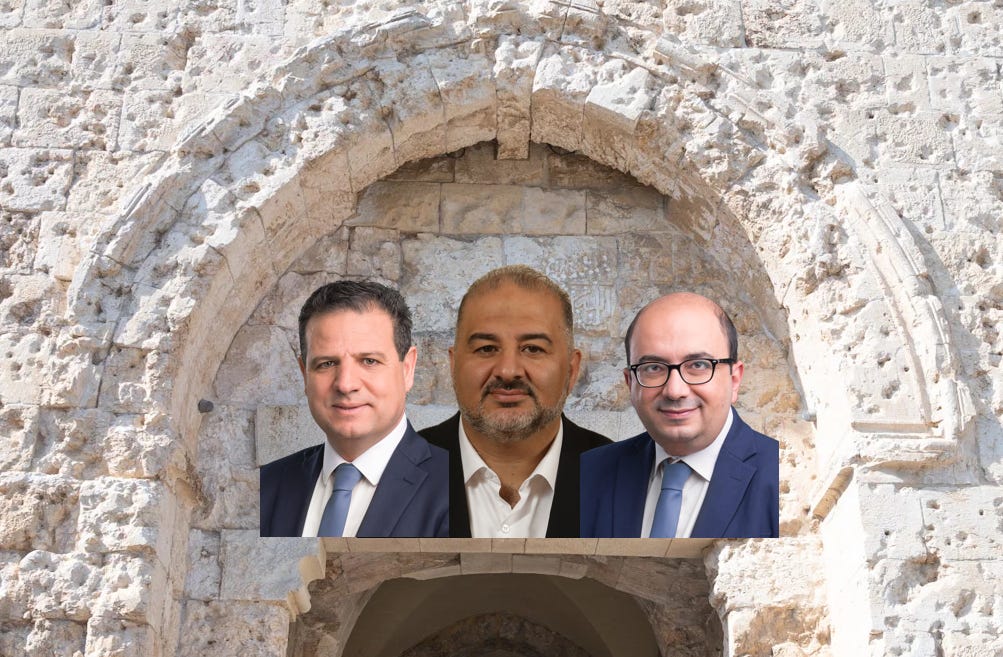
In 2015, for the first time the various Arab-oriented political parties in Israel united to run on a single joint list. That list won 13 seats (out of 120), becoming the third largest party in the Knesset. In response to the results, Ayman Odeh, leader of the Hadash Party (a descendent of Israel’s communist party) within the Joint List quoted Psalm 118:22: אֶבֶן מָאֲסוּ הַבּוֹנִים הָיְתָה לְרֹאשׁ פִּנָּה — “The stone rejected by the builders has become the chief corner stone.” The explicit meaning was that without the participation of the Arab parties, no governing coalition could be formed; the implication of using a verse from the Hebrew Bible to make this point was that the structure to which they would be the corner stone was one that Jewish Israelis themselves would still recognize as their own.
Of course, Odeh was incorrect; the Arab parties were not necessary to forming a government and did not become part of the coalition. Incumbent Prime Minister Benjamin Netanyahu was able to cobble together a bare minimum of 61 seats from among the other right-wing parties and ultra-Orthodox and served another term. But in another sense Odeh correct. While the Joint List was not a necessary component to any governing coalition, they earned enough seats to make it impossible to form a left-wing or centrist government without their participation. If the centrist cost-of-living-focused Kulanu party had not agreed to join a government led by Benjamin Netanyahu’s Likud, but instead joined with the center-left Zionist Union alliance, the centrist liberal Yesh Atid, the left-wing Meretz and the right-wing secular Yisrael Beiteinu, that ideologically disparate coalition would still only have totaled 56 seats. To get to 61, they would have needed an additional outright right-wing or ultra Orthodox party to join, or they would have had to form a national unity government with Likud—or they would have needed the Arab parties.
This situation has obtained ever since, whether the Arab parties run together or separately. As a result, an Arab party did prove essential to forming the only government not led by Netanyahu since 2009. In 2021, the logjam that had prevented any government from being formed after four successive elections finally broke. The reason wasn’t because the Zionist left had done so well or because Likud had done so poorly. Likud got 30 seats, down from the previous 37 but the same as they got in 2015. The Zionist left parties (Labor and Meretz), by contrast, got only 13 seats between them, and even if you add in Yesh Atid’s 17 that’s only as many seats between the three parties as Likud garnered on its own. Meanwhile, the remaining Zionist opposition to Netanyahu tilted far more to the right than in the past. Parties like Yamina (the party name literally means “right”) and New Hope (founded by stalwart former Likudnik Gideon Sa’ar) earning as many seats between them as the Zionist left did, with another 15 seats split between the center-right Blue and White party and Yisrael Beiteinu. No, the reason the opposition was finally able to take power was because they included an Arab party: Mansour Abbas’s pragmatic Islamist party, Ra’am.
Now the Joint List has been reconstituted for another, crucial election—but the context is much grimmer than in 2015. Israel has been governed for the past four years by the most right-wing government in its history, one that has been resolutely hostile to everything that the Zionist left stands for in both domestic and foreign policy. It has corrupted the police and the administration of justice and sought to subordinate both the judiciary and key organs of civil society to the government, following the template of right-wing populist governments in Hungary, Poland, Turkey and India (and now the United States). It has given a free hand to settler violence in the West Bank and, most recently, granted itself a new suite of powers in the territories that in key ways arguably amount to de facto annexation. It has also been profoundly hostile to the interests of Palestinian Israelis, most notably in essentially abandoning Arab cities and neighborhoods to the depredations of organized criminal gangs, which has led to a horrific surge in the murder rate, nearly all of these crimes going unsolved, a development which prompted unprecedented mass protests by joint Jewish and Arab crowds only two weeks ago. Finally, the current government is responsible both for the colossal intelligence and security failure of October 7th, leading to the massacre of over a thousand Israelis and the abduction of hundreds more, and for the ferocious and ongoing war in Gaza launched in response, a war that has caused tens of thousands of Palestinian deaths and physically destroyed much of the infrastructure in the territory, yet has still failed to dislodge or incapacitate Hamas, the perpetrators of those massacres.
The point being that for both the Zionist left and the non- or anti-Zionist parties representing most Palestinian Israelis, the next election feels existential. If the next government is led by Netanyahu’s Likud with a right-wing coalition, even if it doesn’t look precisely like the current one, the voters will effectively have affirmed much if not all of what the government has done and tried to do. The interests of left-wing and liberal Zionists and Palestinian Israeli non-Zionists are, therefore, largely aligned at this moment. And per the electoral history I outlined above, they need each other as a practical matter as well. It is likely that, post-election, the only way the opposition will be able to form a government is by including at least one Arab party (most likely Ra’am), and they might need the entire Joint List to get to a majority.
So the only rational thing for the opposition to do is to unite, truly unite, with the Arab parties. The precedent has already been set for including the latter in a governing coalition, even alongside right wing parties, and prospective voters for the Joint List, when polled, say they want the parties in the list to join the next government if at all possible—at this moment they want to improve their lives and prevent catastrophe, and are not focused on bringing about a sudden revolution in the nature of the Israeli state.
And yet, it is entirely possible that no such deal emerges, and that, as a result, even if he doesn’t win the election outright Netanyahu may remain in power after the election as head of a caretaker government, much as happened repeatedly in 2019 and 2020. Moreover, even saying that they intend to include at least one non-Zionist Arab party in the governing coalition could drive voters away from the opposition Zionist parties, and help return something like the current ultra-right-wing coalition to power. So even though including Arab parties in the next coalition may well be necessary, the opposition Zionist parties may deny that they intend to do so—which, in turn, may make it harder to switch to an embrace post-election.
Why should that be? The reality is that in the wake of October 7th most Jewish Israelis simply have very little willingness to trust Palestinian Arabs collectively, whether they are Israeli citizens or no, and therefore very little willingness to trust their chosen representatives. While there was a lot of opposition to the length of the war in Gaza and the failure for so long to bring the hostages home, and a lot of resentment of the ideological settlers, there’s little concern about the war’s conduct otherwise, and there is essentially no constituency for negotiations toward any kind of Palestinian sovereignty. But the distrust extends back before October 7th, 2023. Right after the 2021 election—the one that brought Ra’am into government—riots broke out in Arab communities and mixed cities across Israel. Buildings were torched, including synagogues, and innocent Jewish people were killed. There was also retaliatory violence by Jews (including radical settlers who traveled in for the occasion) against innocent Palestinian Israelis that claimed lives and property. The immediate political impact was to threaten the formation of a coalition out of the opposition parties, because Yamina’s Naftali Bennett said that Ra’am could not be trusted in government at such a time. A government including Ra’am was ultimately formed—but the longer term political impact was to power the growth of the extreme right that has been so central to the current government. The overtly racist and Jewish supremacist Otzma Yehudit Party joined with the Religious Zionist Party and together earned 14 seats. That unprecedentedly strong result for the extreme right was to a considerable extent the fruit of the violence of May, 2021.
Aware of this history, and of the public mood, everyone to the right of the far left has reason to fear that an outright embrace of even the most pragmatic Arab parties—whether before or after the election—could backfire horrifically. At a minimum, it could power a reaction that saves the extreme right from its much-deserved burial. At worst it could be much worse. Everyone remembers older history too, that Yitzhak Rabin was assassinated in part because his government continued to negotiate under the Oslo framework despite the fact that it had lost its majority and depended on votes from the Arab parties who were not part of the coalition in order to forestall new elections. That, more than anything, is why he was damned as a traitor not only by the far right but even by the mainstream right, and why the extreme right decided that he had to be killed.
Yet in the end, I don’t think there is any alternative but to take the risk. Israel may call itself a Jewish state (whatever that means) but it is also the only state that its Palestinian citizens have, and it needs to represent them, authentically. It’s unfortunate that the nature of the Israeli political system is such that it encourages the proliferation of parties, some of them representing niche ideologies and some the vanity of particular politicians, but many of them affinity-based. It would be much better if Israel’s Palestinian citizens were integrated into larger political blocs, as appeared in fact to be starting to happen in the 1980s and 1990s with the demise of the “satellite” parties propped up by Mapai from the beginning of the state; that process would have necessitated a progressive ideological adjustment by those blocs that would have made further political integration easier as the definition of the nation became more inclusive. But you build coalitions with the political system you have, and Israel’s Arab parties are clearly ready to take much less than half a loaf for a seat at the table. They need and deserve the chance to take that seat, and to genuinely represent their constituents.
The objection that they are not Zionist should have no force. First of all, if that were dispositive then what have the ultra Orthodox parties been doing sitting in government over and over for generations? Those parties and their constituency do pose a challenge to the state—and there are now parties that refuse to ever sit with them for that reason—but nobody, certainly nobody on the Zionist right, has said that they are fundamentally illegitimate because they are not Zionist. But more important, if Israel is a democracy then the voters choose the ideology of the state, not the other way around. Abandon that principle, and you’re on a glide path towards Iran, where the official ideologists decide who is halal and who is haram.
Finally, I have believed for a very long time that the political integration of Israel’s Palestinian citizens is more likely to be a predicate to finally resolving the conflict with the Palestinians who are not citizens than the other way around. The dream of the far right is permanent domination of the land between the river and the sea, with Palestinian Arabs either expelled or progressively confined and excluded from both politics and society. That is a vision that is incompatible with true full integration of Israel’s own Palestinian citizens; on the contrary, it depends on importing ethnic conflict from the West Bank back into Israel proper. Fighting that development is not only essential in its own right but essential to blocking their larger dark vision. By the same token, successful political integration would demonstrate the possibility of true coexistence, and therefore open up space for a much-deferred political horizon for Palestinians who are not citizens, whether in one bi-national state or two states living side by side, or three such states, or some other arrangement for sharing the land and sovereignty therein. The reality is that a permanent divorce, which many Israeli Jews have wanted for a quarter century since the Second Intifada broke out, is not practically possible. All true solutions involve coexistence, founded on mutual respect. If that is the case, then Israel’s Palestinian citizens are already the corner stone. The only question is whether the builders are ready to take them up.