
The Future Has Already Been Born
Are we prepared to face it?

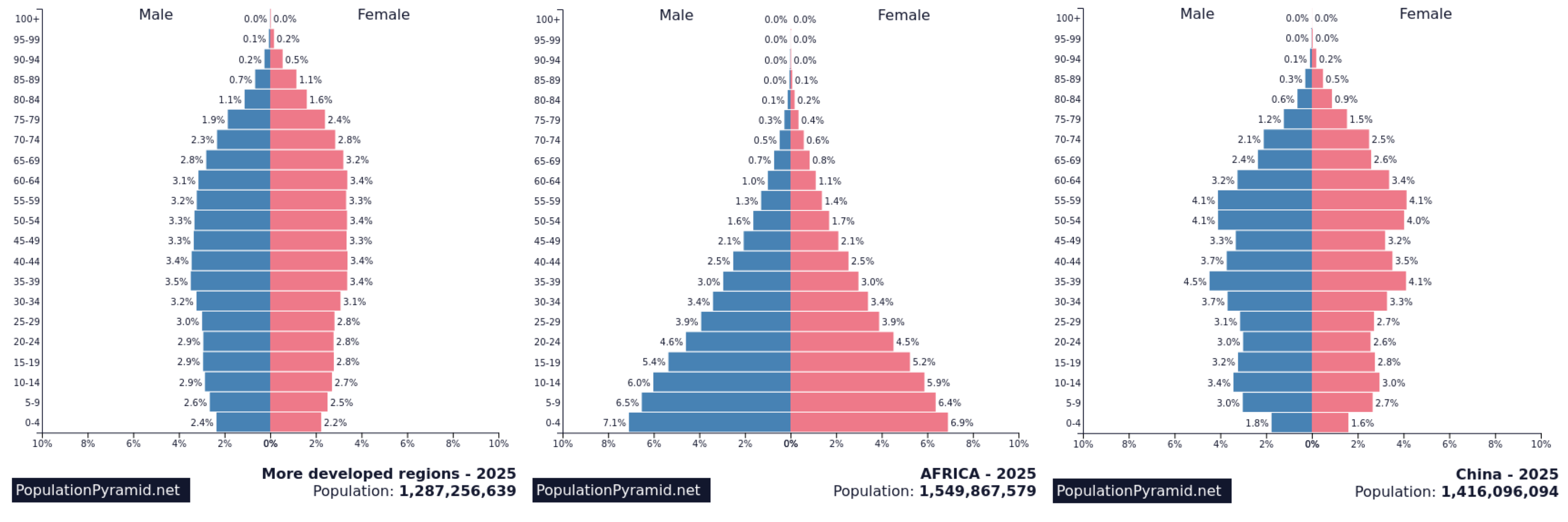
One of these pyramids is not like the others
In 2015, I wrote a piece for Politico entitled “The African Century,” the simple point of which was that the population of Africa was still increasing rapidly while the rest of the world was slowing down or actually shrinking, and that this fact had consequences that could not reasonably be prevented. Perhaps Africa (or large parts of it) would achieve economic liftoff, in which case the continent would become the center of the world economy within decades, much as China did over the course of its few decades of rapid development. Or perhaps Africa would largely fail to achieve lift-off, in which case in a few decades the world’s truly poor would be overwhelmingly African, and that fact would dominate the global humanitarian agenda. Meanwhile, regardless of whether the continent achieved economic liftoff or failed to do so, migration from Africa was going to grow enormously, such that the rest of the world was going to become rapidly more African.
In the decade since, Africa’s official population growth has slowed considerably (though there are legitimate questions about how able countries like Somalia or the Democratic Republic of the Congo to count their population with accuracy), but fertility rates outside of Africa have mostly fallen off a cliff, in some cases from already very low levels. The practical consequence is that while global population is likely to peak materially lower than it appeared it would back in 2015, the percentage of the global population that is going to be of African origin in the future might be even larger it seemed it would be a decade ago.
Here’s a good way to think about the present and the near future. In 2015, roughly 16% of the world’s population lived in Africa. (That’s a bit less than double what Africa’s share of the globe’s population was in 1950, or in 1900 for that matter.) By 2025, Africa accounted for roughly 19% of the world’s population—but for fully 30% of the world’s children under 15 years, and 36% of the world’s births. The future has already been born—and the future is much, much more African than the past was.
Africa is not the only region of the world that is still growing demographically, though Africa is growing much faster than any other region. The Middle East and Central Asia are also still growing, and South Asia is growing as well (though India, the most populous country in the region and in the world, now has a fertility rate just below replacement). In 2025, roughly 30% of the world’s population lived in these regions, and in the same year 33% of the world’s children under 15 lived there, and roughly 33% of the world’s births took place there as well.
These regions of the world—Africa, South Asia, Central Asia and the Middle East—together represent just under 50% of the world’s current population. But they are the homes of nearly 70% of the world’s children currently being born. The entire rest of the world—North and South America, Europe, East Asia, Southeast Asia and Oceania—only accounts for the remaining 30% of current births. The labor force of the future, the consumer base of the future, the military manpower base of the future—the demographics of these are all downstream of these simple facts about who is being born and where.
Those facts could change, of course. But because of demographic momentum, any change would have to be enormous to make any material difference to what the world will look like in fairly short order. Regardless of one’s views on trying to use policy levers to change fertility, it’s worth being aware of the degree to which the cake is already baked.
This is where my mind goes when I read something like Ed West’s recent piece, “The Whole World Is On the Move,” about chain migration and the difficulty it poses to wealthy societies simply trying to maintain some kind of control and order around immigration without being wantonly cruel. West is writing about very important things, and I understand why: he wants Western governments to reckon with just how mobile the world has become and how quickly things can get out of control, as they did in the early 2020s both in the United States and in the UK. He wants us to make decisions with our eyes open before it’s too late, if it isn’t already too late.
There’s a larger picture behind that already quite big picture, though, and that’s the picture I’m trying to paint. Stories about the large percentage of Nicaraguans or Bhutanese who left their home countries to settle in America or Australia are dramatic, but the disparity in scale between the sending country and the recipient mean that the more dramatic part is the emptying out rather than the filling up. When you look at the global picture, though, the balance—by which I mean the balance of power—shifts.
We do have choices about how to respond to the demographic facts about the world’s future population, but those facts will matter regardless of how we deal with them. There is a big difference, for example, between inviting in a large population of workers and making them citizens (the historic American approach), inviting in a large population of workers and refusing to let them be citizens (the approach of countries like the UAE and Singapore), and letting few workers in and instead exporting a great deal of capital and employing large numbers of non-citizens in their homes abroad (the historic Japanese approach, and increasingly China’s). These are all valid responses to a dramatic disjunction between where the people are and where the economic opportunity is; they impose a different mix of costs and burdens from each other and generate different gains, in different places and for different people. But all of these choices still involve entanglement between one society and another: politically, economically and culturally. And in negotiating those entanglements, the shift as the demographic balance will shift the balance of power with it. We are not the only party to this global renegotiation.
To some degree it has always been thus. I’m reading The Grapes of Wrath right now; the migration from Dust Bowl Oklahoma to California was culturally, politically and economically disruptive, even though it involved predominantly White American citizens moving from one part of the country to another. Germany once invited in Turkish guest workers but made it extremely difficult for them or their children to obtain citizenship; they changed their policy not just because they grew soft-hearted or guilt-wracked but because having a large, permanently resident non-citizen population presented a growing and ominous social and political problem, and a challenge, ultimately, to democratic legitimacy. The United States did a lot of offshoring in the 1990s and 2000s, a trend that is now blamed for the deindustrialization of the Midwest and the political ructions that have followed.
But just because these things have happened before doesn’t mean this time won’t be different, because, as Stalin purportedly said, quantity has a quality all its own. Just as the China shock was way, way bigger than the shocks from previous rounds of integration of newly industrializing countries, the demographic “shock” that we’re already feeling even as it continues to grow is qualitatively different because it is quantitatively so much larger. Which is just to say that, in a world where Nigeria had more babies last year than all of Europe, and twice as many babies as the United States, we are increasingly going to have to deal with Nigerians one way or another, and that necessity will meaningfully constrain our freedom of action (or, if you prefer, impose significant costs on the exercise of that freedom).
That thought doesn’t fill me with dread. I’m not Tom Buchanan. I’m a New Yorker born and bred; I’ve always lived in a polyglot society, and at a deep psychological level high levels of immigration and of cultural diversity seem both normal and actively good to me. But I can also read a spreadsheet, and I can also read a poll. We don’t seem to be dealing particularly well with the idea that there even are necessities these days, much less that some of them will be unpleasant to lots of people. That does make me dread the prospect of their looming even larger and more obviously as we hurry toward an entirely predictable future.
California attempted to enforce domestic interstate border control against the Okies during the 1930s Dust Bowl.
I believe the Okies are why Bakersfield, California, has its own school of country music.
https://www.smithsonianmag.com/history/los-angeles-1936-bum-blockade-targeted-american-migrants-fleeing-poverty-and-drought-during-the-great-depression-180987022/
https://en.wikipedia.org/wiki/Bakersfield_sound
I commented on Mr. West's story: "To me, among the most striking facts is that "Mohammed" in all its variations is the most common name for newborn boys in England, Wales, London, Manchester, Berlin, Brussels, Amsterdam, The Hague, Oslo, etc. A million migrants is a statistic, but a name is a concrete expression of specific human values and visions for the future."
More and more it seems to me that the public debate deals poorly with the question of cultural change, and displaces this question onto other questions which fail to resolve the underlying question of cultural change. Perhaps primarily because cultural change is fundamentally 'soft' and qualitative (though it can be measured via things like baby names) and thus fits poorly with the reigning modern episteme for which only measurable facts are really 'real.'
The Left are either relativists who hold that all cultures are equally good, or progressives who hold that increasing the proportion of non-Europeans in any society is good because it helps lessen the taint of 'whiteness,' slavery, colonialism, etc.
The Center-Left and Center-Right can point to spreadsheets saying that more people makes a bigger economy, and more is better ('One Billion Americans').
The Right dislikes or is unhappy about cultural change but often fails to articulate this in a comprehensible way. In the US, the Respectable Right is inhibited from acknowledging that they fear cultural change (because KKK/Hitler/White Supremacy), and feels compelled to frame the question entirely in terms of crime and economics, for which the Center and Left have ready rebuttals.
On the Hard Right, some percentage of people genuinely dislike non-white and non-European people, which then justifies their shunning and anathematization by the mainstream. But a much larger number (I believe) simply want to maintain their existing cultural values against rapid change (even before getting to whether the change is good or not), but have a great deal of trouble making this case in public--it is easily and unfairly dismissed as 'racist,' because the 'soft' and qualitative problem of 'preserving cultural values' has trouble fitting into the 'spreadsheet brain' that governs discourse for the Center Left and Center Right.