

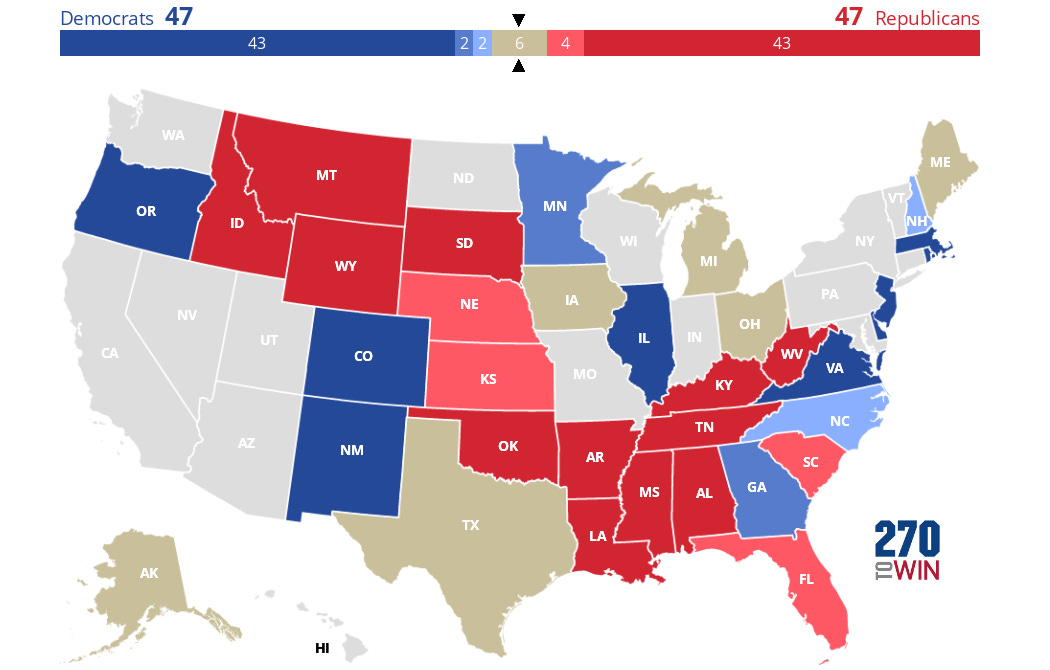
Here are some recent polls from the 2026 contest for the United States Senate in various states:
Alaska (Alaska Survey Research, August 20-23)
Mary Peltola (D): 51%
Dan Sullivan (R): 49%Georgia (Trafalgar Group, September 10-12)
John Ossoff (D): 49%
Mike Collins (R): 43%Iowa (YouGov, September 3-8)
Josh Turek (D): 45%
Ashley Hinson (R): 43%Kansas (co/efficient, September 8-10)
Roger Marshall (R): 49%
Adam Hamilton (D): 44%Maine (YouGov, September 2-8)
Troy Jackson (D): 48%
Susan Collins (R): 44%Michigan (Trafalgar Group, September 7-9)
Abdul El-Sayed (D): 46%
Mike Rogers (R): 45%Minnesota (Quantus Insights, September 8-10)
Peggy Flanagan (D): 49%
Michele Tafoya (R): 45%Montana (Rutgers-Eagleton, August 27-September 7)
Kurt Alme (R): 38%
Seth Bodnar (I): 30%Nebraska (SurveyUSA, September 8-13)
Dan Osborn (I): 46%
Pete Ricketts (R): 42%New Hampshire (co/efficient, September 9-11)
Chris Pappas (D): 46%
John Sununu (R): 46%North Carolina (Trafalgar Group, September 8-10)
Roy Cooper (D): 48%
Michael Watley (R): 42%Ohio (InsiderAdvantage, September 8-9)
Sherrod Brown (D): 47%
John Husted (R): 42%South Carolina (InsiderAdvantage, September 8-9)
Darlene Graham (R): 45%
Annie Andrews (D): 43%South Dakota (Public Policy Polling, September 8-9)
Mike Rounds (D): 45%
Brian Beng (I): 43%Texas (SoCal Strategies, September 12-13)
James Talarico (D): 50%
Ken Paxton (R): 45%
That’s a wide range of different states, with very varied politics, and all of these races are within ten points. If that surprises you, it’s worth asking yourself why. Because that’s exactly what the median voter theorem says most races should be like.
Now, to be fair, there are a variety of reasons why the median voter theorem shouldn’t apply to races for the United States Senate, most prominently the role party primaries play in selecting the nominees (which pull both nominees toward the views of activists who dominate primaries), and the transformation of the senate into a more partisan body, in large part in response to the increasingly partisan nature of the presidency (which pushes a same-party senate to support the president and an opposite-party senate to obstruct). Nonetheless, both candidates and primary electorates have a strong incentive to push the center of each contest toward the positions of the median voter. And we’ve seen that force operating in both red and blue states this year.
In Alaska, for example, the Democratic Party lined up behind Mary Peltola, whose moderate, pro-fish and pro-oil politics are in tune with the views of median Alaskans, while in New Hampshire the Republican Party nominated the scion of the state’s most prominent political family to put the state into play. In Michigan, by contrast, the Democrats nominated a candidate with a meaningfully more left-wing profile than the state’s median voter, and in Texas the Republicans nominated an extremely controversial candidate beloved of the MAGA base and loathed by just about everybody else. Their opponents in each case are fairly generic representatives of their respective parties. As a result, all four races are currently polling fairly close.
From one perspective, some of this behavior is irrational. Michigan Democrats and Texas Republicans should have picked more mainstream nominees who could have coasted to victory based on their states’ respective partisan leans. But from the perspective of the people who dominate primary voting, maximizing the chance of victory in the general election isn’t and shouldn’t be the only factor. MAGA Republicans in Texas could rationally be thinking about the future of their movement post-Trump, just as progressive Democrats in Michigan could rationally be thinking about the future direction of their party, and in both cases they might sacrifice some chance of winning the seat for the sake of winning that intra-party contest (though, I have to say, there must have been somebody less disgusting than Paxton who Texas Republicans might have picked for that purpose). They might make the wrong calculation in that regard, but taking some risk for some reward does make rational sense.
Indeed, there’s an argument to be made that if everyone was behaving rationally, all races without a strongly popular incumbent would be contested, and closely so. In a state dominated by Democrats, the party would pull its nominees to the left, and the Republicans would, in response, rationally put up more moderate and independent nominees to contest those elections. In a state dominated by Republicans, the opposite would happen, and in a state split between the parties, either both parties would hew to the center or both would do the opposite, and present the voters with a stark choice between extremes. In effect, any race without a popular incumbent that isn’t close implies that one or the other party has left metaphorical money on the table, either blowing races that could have been seriously contested or nominating someone more cautious than was necessary to win, and who will therefore likely deliver similar caution in office, and hamper the party from achieving its goals. (I say “cautious” rather than “moderate” or “centrist” because centrists and moderates can also call for dramatic changes or reforms, which will likely prove polarizing, and therefore politically costly, even if they aren’t identified with either ideological extreme.)
What generally stops this from happening? As noted, one thing is the effect of a partisan presidency, which polarizes senate elections around the state’s view of the president. You can see this playing out in the Michigan race, where Abdul El-Sayed’s main line of attack against Mike Rogers is that he has been unwilling to put any distance between himself and a very unpopular president. Another is the effect of national financing on candidate selection; in 2020, for example, the Democrats nominated numerous senate candidates who were able to raise vast sums of money nationally by appealing to a national audience of donors, but then found themselves out of step with their states’ politics and so unable to convert those dollars into votes. The closeness of numerous races this year, however, suggests that there may be a learning curve on both points—that there may be a limit to voters’ willingness to reduce their senate vote to an expression of either loyalty or disdain for their president, and that donors are sufficiently interested in winning to learn from their mistakes about what it takes to win.
But the last very important test is whether the leadership of either party will reflect the political complexion of the caucus or attempt to enforce discipline in an excessive way. If Dan Osborn wins a seat in Nebraska or Seth Bodnar wins one in Montana, the Democrats will have less practical ability to enforce discipline, not only on them but on anyone—because if their majority depends on true independents, then everyone in the caucus should have the practical ability to exercise more independence, using them as cover. Even if they both lose, though, any Democratic majority is only going to endure if the leadership makes room both for people like them and for people like El-Sayed, which simply means less discipline overall, at least in the senate. Which, as it happens, is how the senate was designed to work.
In any event, I find it hopeful that a Democrat is trying to make it a real race in Kansas. And while I know which team I’m rooting for, that also means that in principle I should be pleased that Republicans are trying to make it a real race in Minnesota. Close elections mean accountability, and accountability is democracy in action. I want to see more of it, not less.
Super stimulating read on technological evolution and human agency. Keeping philosophical rigor alive while tools evolve so quickly is the best antidote to intellectual complacency. Shared some related thoughts on the boundary of knowledge and testability here: https://gzambrano.substack.com/p/the-limit-of-the-testable-a-dialogue-in-three-acts
Median voter theory doesn't mean every race should be close in a two-party system. There is no way any conceivable Democrat could win in WY, because WY voters deeply identify as Republican.
Dan Osborn is a case in point. He has a chance BECAUSE he is not running as a Democrat. No Democrat can win Senate in NE for the same reason as WY.
Median Voter Theory in a different electoral structure would work more powerfully. Ranked choice voting, proportional representation, old-fashioned fusion voting, federal anti-gerrymandering law would all push congressional races towards the median voter.